
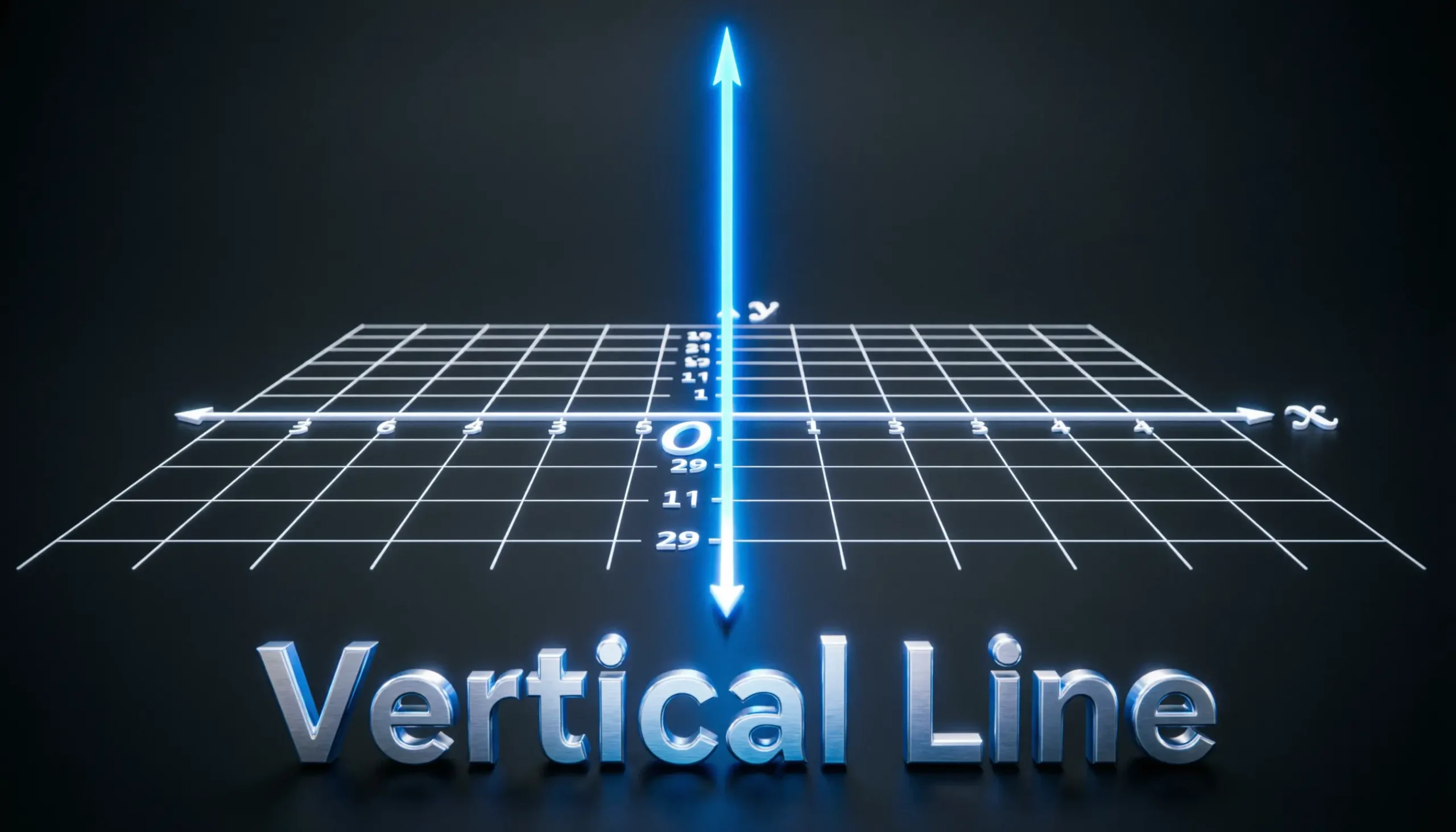
A vertical line is one of the simplest and most important ideas in geometry. It is a straight line that goes up and down, usually parallel to the y-axis on a coordinate plane. Students see vertical lines in graphs, buildings, doors, poles, trees, and many everyday objects. Learning how to identify a vertical line also helps with coordinate geometry, slopes, equations, and graph reading. In this guide, we will explain the vertical line definition, vertical line examples, its slope, equation, and difference from a horizontal line in simple language.
What Is a Vertical Line?
A vertical line is a straight line that moves from top to bottom or bottom to top. On a coordinate plane, a vertical line runs parallel to the y-axis. Every point on a vertical line has the same x-coordinate, while the y-coordinate can change. This makes vertical lines easy to identify when working with graphs and basic geometry.
- 📏 A vertical line goes up and down.
- ⬆️ It can extend upward without stopping.
- ⬇️ It can also extend downward.
- 📐 It forms a 90-degree angle with a horizontal line.
- 🧭 It is parallel to the y-axis.
- 📊 It appears upright on a standard graph.
- 🔢 Its x-coordinate stays constant.
- 📍 Its y-coordinate can change.
- 🏢 A building wall can look vertical.
- 🚪 A door frame can show a vertical line.
- 🌳 A straight tree trunk can look vertical.
- 💡 A lamp post is usually vertical.
- 📚 A book standing upright can show vertical edges.
- 🧮 Vertical lines are important in coordinate geometry.
- ✏️ Students can draw them with a ruler.
- ⭐ They are easy to recognize by their up-and-down direction.
The key idea is simple: a vertical line travels straight up and down. On a coordinate graph, it is parallel to the y-axis and has one fixed x-value. Once students understand this basic idea, many coordinate geometry questions become easier.
Vertical Line on a Coordinate Plane
A coordinate plane has two main axes: the horizontal x-axis and the vertical y-axis. A vertical line runs in the same direction as the y-axis. If a line passes through points such as (3, 1), (3, 4), and (3, 7), the x-coordinate is always 3. Therefore, its equation is x = 3.
- 📊 Coordinate planes contain two main axes.
- ➡️ The x-axis runs horizontally.
- ⬆️ The y-axis runs vertically.
- 📏 A vertical line follows the y-axis direction.
- 📍 Its x-coordinate stays the same.
- 🔢 Its y-coordinate changes.
- ✏️ Points can be plotted on the line.
- 🧮 An equation can describe the line.
- 📌 Example: x = 3 is vertical.
- 📌 Example: x = -2 is also vertical.
- 🟢 Point (3, 2) can lie on x = 3.
- 🔵 Point (3, 6) can also lie on x = 3.
- 📈 The line does not move left or right.
- 🧭 It remains parallel to the y-axis.
- 📚 This idea is common in school geometry.
- ⭐ Constant x-values are a useful clue.
When you see a coordinate equation such as x = 5, you can immediately identify it as a vertical line. The number 5 tells you where the line sits from left to right, while the line extends through every possible y-value.
Equation of a Vertical Line
The equation of a vertical line has a very simple form: x = a, where a is a constant number. For example, x = 4 represents a vertical line passing through every point whose x-coordinate is 4. Unlike many other line equations, a vertical line cannot be written in the usual slope-intercept form y = mx + b.
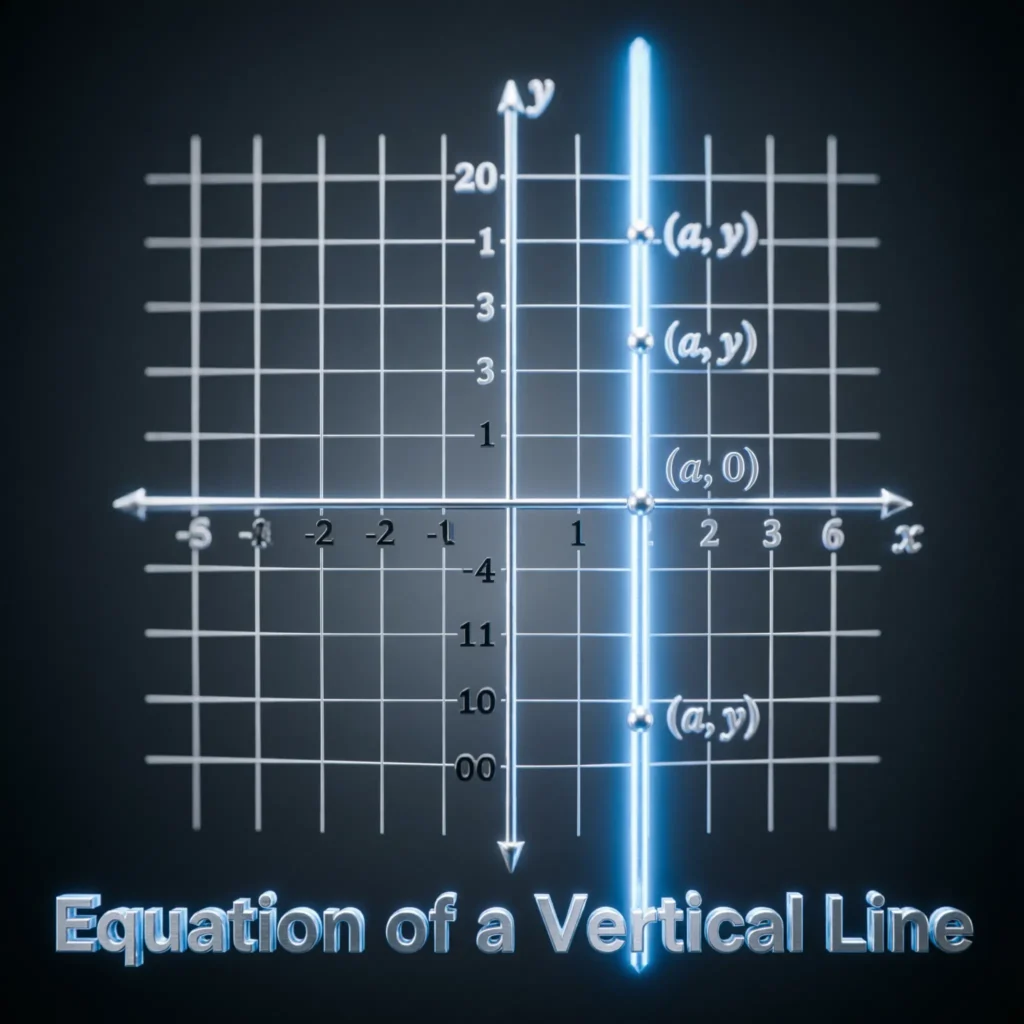
- 🧮 The basic form is x = a.
- 🔢 The value of a stays constant.
- 📍 x = 2 is a vertical line.
- 📍 x = -5 is a vertical line.
- 📍 x = 0 is the y-axis.
- 📊 The line crosses the x-axis at a.
- ⬆️ It continues upward.
- ⬇️ It continues downward.
- 🧭 It stays parallel to the y-axis.
- ✏️ Any y-value can appear on the line.
- 📌 x = 7 includes points like (7, 1).
- 📌 It also includes (7, 10).
- 📚 This form is useful in coordinate geometry.
- 📝 It is common in algebra questions.
- 🔍 A constant x-value identifies the line.
- ⭐ Remember: vertical means x is constant.
The equation x = a is one of the easiest line equations to recognize. If the equation gives a fixed x-value and does not include y, the graph is a vertical line. This rule is especially useful in exams and coordinate geometry exercises.
Slope of a Vertical Line
The slope of a vertical line is described as undefined. Slope measures how much a line rises compared with how much it moves horizontally. A vertical line has no horizontal change, so the denominator in the slope formula becomes zero. Since division by zero is not defined, the slope of a vertical line is undefined.
- 📐 Slope measures line steepness.
- 🧮 The slope formula uses change in y.
- ➡️ It also uses change in x.
- 📏 A vertical line has zero horizontal change.
- 🔢 Its change in x is 0.
- ⚠️ Division by zero is undefined.
- 📊 Therefore, vertical-line slope is undefined.
- ⬆️ The line rises vertically.
- 🧭 It does not move sideways.
- ✏️ Students often confuse undefined with zero.
- ❌ Vertical slope is not zero.
- ➖ A horizontal line has zero slope.
- 📚 This difference is important in exams.
- 🔍 Check the direction before calculating slope.
- 📝 Use the slope formula carefully.
- ⭐ Remember: vertical = undefined slope.
A common exam mistake is saying that a vertical line has a slope of zero. That is incorrect. A horizontal line has zero slope, while a vertical line has undefined slope. Remembering this simple comparison can prevent many coordinate geometry errors.
Vertical Line vs Horizontal Line
Vertical and horizontal lines are opposite in direction. A vertical line goes up and down, while a horizontal line goes from left to right. They also have different slope properties. A vertical line has an undefined slope, while a horizontal line has a slope of zero. These two line types are basic building blocks of coordinate geometry.
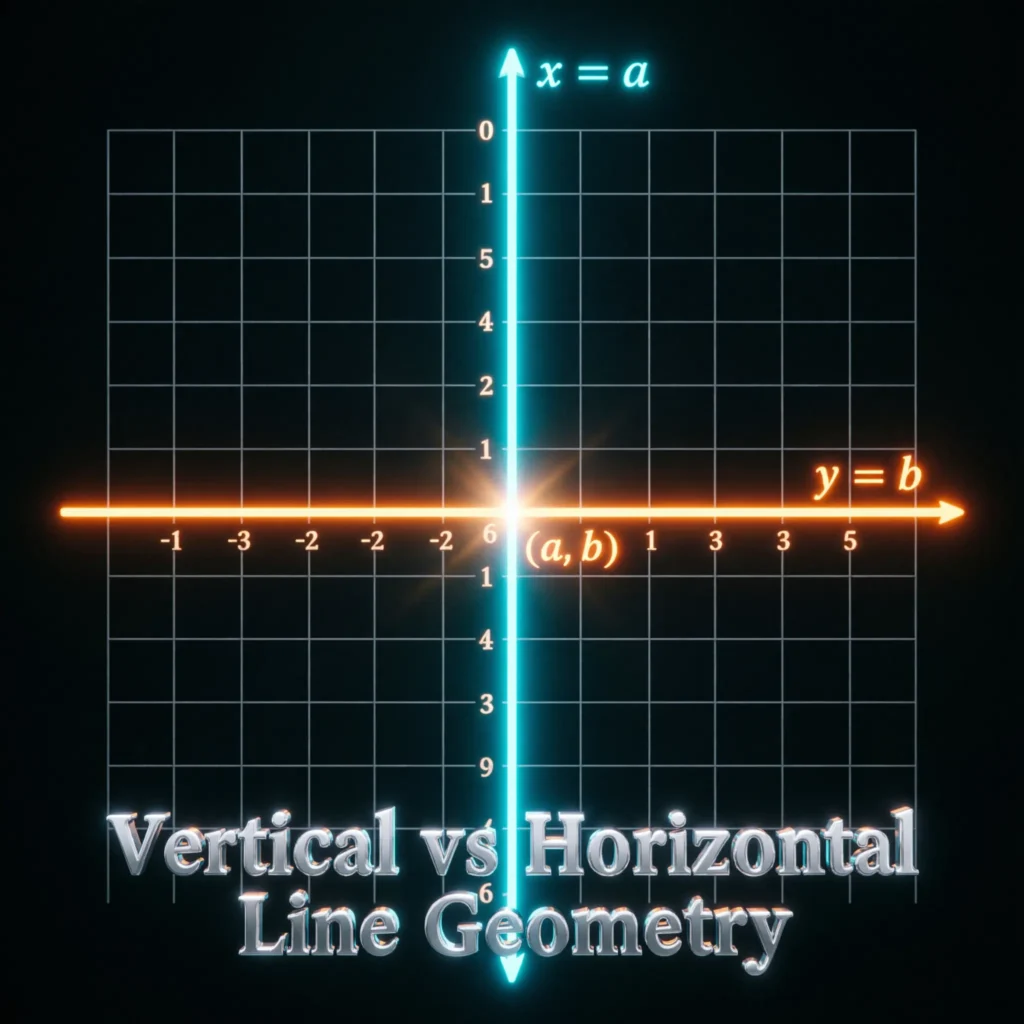
- ⬆️ Vertical lines go up and down.
- ➡️ Horizontal lines go left and right.
- 🧭 Vertical lines are parallel to the y-axis.
- 📊 Horizontal lines are parallel to the x-axis.
- 🧮 Vertical slope is undefined.
- 🔢 Horizontal slope is zero.
- 📍 Vertical equations look like x = a.
- 📍 Horizontal equations look like y = b.
- 📐 They meet at right angles.
- 🏢 Walls can look vertical.
- 🛣️ Roads can look horizontal.
- 📚 Both are important in geometry.
- ✏️ Both can be drawn with a ruler.
- 🔍 Direction helps identify them.
- 📝 Both appear in coordinate graphs.
- ⭐ Learning the difference helps with exams.
The easiest way to remember the difference is to focus on direction. Vertical means up and down; horizontal means side to side. On a graph, vertical lines keep x constant, while horizontal lines keep y constant.
Vertical Line and the Y-Axis
The y-axis is itself a vertical line. It is the line where the x-coordinate equals zero. Every point on the y-axis has an x-coordinate of 0, while its y-coordinate can be positive, negative, or zero. Understanding this relationship helps students identify vertical lines on coordinate planes.
- 🧭 The y-axis is vertical.
- 📍 Its equation is x = 0.
- 🔢 Every point has x = 0.
- ⬆️ It extends upward.
- ⬇️ It extends downward.
- ➕ Positive y-values are above the origin.
- ➖ Negative y-values are below the origin.
- 🎯 The origin is at (0, 0).
- 📊 The y-axis divides the plane.
- ✏️ It helps locate coordinates.
- 🧮 It is used in graphing.
- 📚 It is a basic geometry concept.
- 🔍 A point on the y-axis has no left-right distance.
- 📌 Example: (0, 5) lies on the y-axis.
- 📌 Example: (0, -3) also lies on it.
- ⭐ The y-axis is a special vertical line.
The y-axis is simply a special case of a vertical line. Instead of x = 3 or x = -2, its equation is x = 0. Knowing this makes it easier to understand both coordinate graphs and equations of vertical lines.
Vertical Lines and Perpendicular Lines
A vertical line and a horizontal line are always perpendicular when they intersect. Perpendicular lines meet at a 90-degree angle. This relationship is important in geometry because many shapes contain right angles formed by vertical and horizontal sides.
- 📐 Perpendicular lines meet at 90 degrees.
- ⬆️ A vertical line goes up and down.
- ➡️ A horizontal line goes side to side.
- 🧭 They meet at a right angle.
- 🏠 Walls and floors can form right angles.
- 🚪 Door frames can meet floors at right angles.
- 📐 Squares contain perpendicular sides.
- ▫️ Rectangles have perpendicular corners.
- 📚 Geometry uses perpendicular lines often.
- ✏️ Rulers can help draw them.
- 📊 Coordinate graphs show this clearly.
- 🔢 Vertical and horizontal slopes differ.
- 🧮 Vertical slope is undefined.
- ➖ Horizontal slope is zero.
- 🔍 Their directions make identification easy.
- ⭐ Perpendicularity is a key geometry idea.
A vertical line does not have to be perpendicular to every line it meets. It is perpendicular specifically to a horizontal line when the two intersect at 90 degrees. This idea appears frequently in geometry, architecture, graphs, and measurements.
Real-Life Examples of Vertical Lines
Vertical lines are everywhere in everyday life. Buildings, poles, walls, door frames, and many other objects have edges or structures that appear vertical. These examples help students connect geometry with the physical world. Although real objects may not be perfectly vertical, their main direction can often be described using the idea of a vertical line.
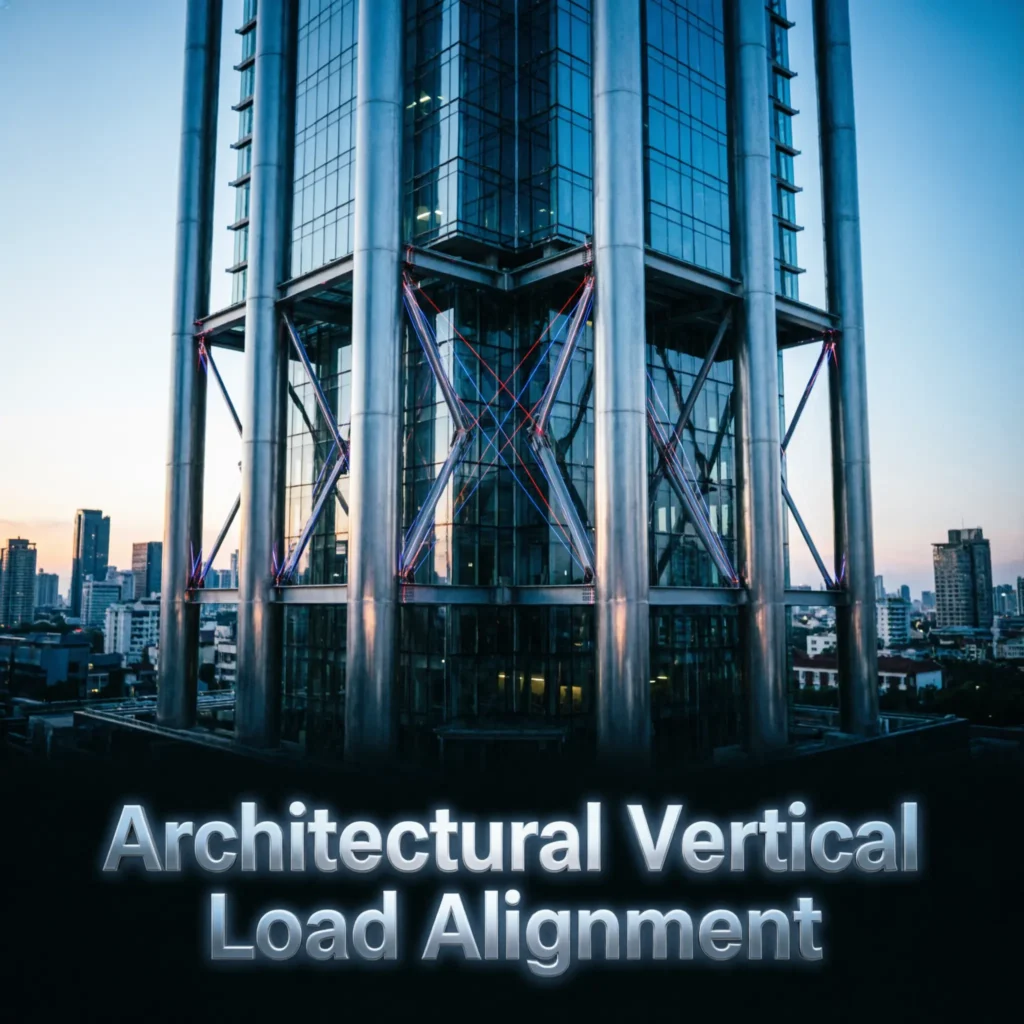
- 🏢 Building walls can be vertical.
- 🚪 Door frames often have vertical sides.
- 🪟 Window edges can be vertical.
- 💡 Lamp posts are usually vertical.
- 🌳 Straight tree trunks can appear vertical.
- 🚦 Traffic-light poles can be vertical.
- 🏗️ Construction columns can be vertical.
- 🏠 House corners can have vertical edges.
- 🪜 Ladder sides can stand vertically.
- 🏛️ Columns can be vertical.
- 🏙️ Skyscraper edges can appear vertical.
- 🏀 Basketball hoops use vertical supports.
- 🚧 Signposts can be vertical.
- 🧱 Brick walls contain vertical edges.
- 📚 Books standing upright show vertical edges.
- 🎨 Vertical lines are common in design.
These examples make the concept easier to remember. When you see something that travels mainly from the ground toward the sky, its direction can often be described as vertical. Geometry becomes easier when students connect textbook ideas to objects they see every day.
Vertical Lines in Geometry Shapes
Vertical lines are common parts of geometric shapes. Rectangles and squares often have vertical sides, while their top and bottom sides are horizontal. Some triangles and other polygons may also contain vertical sides depending on how they are positioned on a page or coordinate plane.
- ▫️ Squares have vertical sides.
- ▭️ Rectangles have vertical sides.
- 🔺 Some triangles can have vertical sides.
- 🔷 Polygons may include vertical edges.
- 📐 Vertical sides can meet horizontal sides.
- ⬆️ Vertical edges have an up-down direction.
- 📏 They can be measured with rulers.
- 🧮 Coordinates can describe their locations.
- 📊 Graphs can display shape edges.
- 🔍 Their direction helps identify them.
- ✏️ Students can draw vertical sides.
- 📝 Geometry exams often use vertical segments.
- 📐 Vertical sides may form right angles.
- 🏠 Shapes in architecture use similar patterns.
- 🎨 Designers use vertical geometry.
- ⭐ Vertical edges help create clear shapes.
A vertical line does not need to continue forever to be useful in geometry. A vertical line segment can form one side of a square, rectangle, or other shape. This is an important distinction between an infinite line and a finite line segment.
Vertical Line Segment
A vertical line segment is a limited part of a vertical line. Unlike a complete line, which continues endlessly in both directions, a line segment has two endpoints. For example, the segment connecting (4, 2) and (4, 8) is vertical because both endpoints have the same x-coordinate.
- 📏 A line segment has two endpoints.
- ⬆️ A vertical segment goes up and down.
- 📍 Its endpoints have the same x-coordinate.
- 🔢 The y-values are different.
- 📌 (4, 2) and (4, 8) form a vertical segment.
- 📐 Its length can be measured.
- 🧮 Coordinate geometry can describe it.
- ✏️ A ruler can help draw it.
- 🏠 Shape sides can be vertical segments.
- ▫️ Rectangles contain vertical segments.
- 📐 Squares contain vertical segments.
- 📝 Exams often ask for segment length.
- 🔍 Equal x-values are a useful clue.
- 📊 It appears clearly on coordinate graphs.
- 🧭 Its direction remains vertical.
- ⭐ It has a fixed beginning and ending point.
The key difference is length and endpoints. A vertical line extends forever, while a vertical line segment has a definite length. If two points have the same x-coordinate, the segment joining them is vertical.
Vertical Line and Distance Between Points
Finding the distance between two points on a vertical line is especially simple. Since the x-coordinate does not change, you only need to find the difference between the y-values. For example, the distance between (2, 3) and (2, 9) is 6 units.
- 📍 Both points have the same x-coordinate.
- 🔢 Compare their y-values.
- 🧮 Subtract the smaller y-value from the larger.
- 📏 The answer gives vertical distance.
- 📌 (2, 3) and (2, 9) are vertically aligned.
- ➖ 9 − 3 = 6.
- ⭐ The distance is 6 units.
- 📊 This works on coordinate planes.
- ✏️ A number line can help.
- 📐 No horizontal movement occurs.
- 🧭 The x-coordinate remains constant.
- 📚 This is useful in coordinate geometry.
- 📝 It can appear in exam questions.
- 🔍 Check that x-values match.
- 📏 Use units when required.
- 🎯 The method is quick and simple.
When two points share the same x-coordinate, calculating their vertical distance is easy. Just find the absolute difference between their y-values. This is a useful shortcut for students working with coordinate geometry problems.
Vertical Line in Graphs and Equations
Graphs make vertical lines easy to see because their direction is clearly different from horizontal or slanted lines. A vertical line can represent a fixed x-value. For example, x = -4 creates a vertical line passing through every point whose x-coordinate is -4.
- 📊 Graphs display vertical lines clearly.
- 📍 x = 1 creates a vertical line.
- 📍 x = -4 creates another vertical line.
- 🔢 The x-value stays constant.
- ⬆️ The line continues vertically.
- ⬇️ It extends in both directions.
- 🧮 Every y-value can occur.
- 📌 (1, 0) lies on x = 1.
- 📌 (1, 5) also lies on x = 1.
- 📌 (1, -3) also lies on it.
- 📈 The line is parallel to the y-axis.
- 🧭 It does not tilt left or right.
- ✏️ Graph paper helps draw it.
- 📝 Equations can describe its position.
- 🔍 Constant x is the main clue.
- ⭐ This is important for algebra and geometry.
The equation and graph tell the same story. x = 1 means every point on the line has an x-coordinate of 1. The y-coordinate can take any value, so the line stretches upward and downward forever.
Vertical Lines in Architecture and Design
Vertical lines are widely used in architecture and design because they can make structures look tall, balanced, and stable. Columns, walls, windows, doors, and building edges often use vertical directions. Designers also use vertical patterns to guide the eye upward and create a sense of height.
- 🏢 Skyscrapers use strong vertical edges.
- 🏛️ Columns often stand vertically.
- 🚪 Doors have vertical sides.
- 🪟 Windows can have vertical frames.
- 🧱 Walls commonly use vertical edges.
- 🏠 House corners can be vertical.
- 🏗️ Structural columns can be vertical.
- 🎨 Designers use vertical patterns.
- 📐 Architects work with geometric directions.
- 📏 Measurements help maintain alignment.
- 🧭 Vertical alignment supports visual balance.
- 🌆 Tall buildings emphasize vertical lines.
- 🪵 Wooden structures can use vertical posts.
- 🏰 Historic buildings often feature columns.
- 🖼️ Interior design can use vertical patterns.
- ⭐ Vertical lines can create a sense of height.
In architecture, vertical lines are both practical and visual. They can help support structures while also affecting how a building looks. This is a good example of how a simple geometry concept can have a real-world purpose.
Why Students Should Learn Vertical Lines
Understanding vertical lines helps students build a strong foundation for coordinate geometry, algebra, graphs, and shape analysis. The concept is simple, but it appears in many different types of questions. Learning a few key rules can make these problems much easier to solve.
- 📚 Vertical lines are common in geometry.
- 🧮 They appear in coordinate equations.
- 📊 They appear on graphs.
- 📐 They help explain perpendicularity.
- 📝 They appear in school exams.
- 🔢 They use constant x-values.
- ⬆️ They have an up-down direction.
- 📏 They help with distance problems.
- 🧭 They are parallel to the y-axis.
- ⚠️ Their slope is undefined.
- ➖ Horizontal lines have zero slope.
- ✏️ They are easy to draw.
- 🔍 They can be identified from coordinates.
- 🏠 Real objects provide simple examples.
- 🎯 They support later algebra skills.
- ⭐ Mastering the basics prevents common mistakes.
The most useful rules are easy to remember: vertical lines go up and down, stay parallel to the y-axis, have a constant x-coordinate, and have an undefined slope. Once these ideas are clear, many geometry and coordinate problems become much easier.
Common Questions About Vertical Lines
Students often have similar questions when learning about vertical lines. The answers usually depend on three simple ideas: direction, coordinates, and slope. Knowing these basics can help you quickly solve common geometry questions and explain your reasoning clearly in an exam.
- ❓ What is a vertical line? A line that goes up and down.
- ❓ What axis is vertical? The y-axis.
- ❓ What is the slope? Undefined.
- ❓ What stays constant? The x-coordinate.
- ❓ What is its equation? x = a.
- ❓ Is x = 4 vertical? Yes.
- ❓ Is x = -2 vertical? Yes.
- ❓ Is x = 0 vertical? Yes, it is the y-axis.
- ❓ What is a horizontal line? A line that goes left to right.
- ❓ What is a horizontal slope? Zero.
- ❓ Do vertical and horizontal lines meet at 90 degrees? Yes.
- ❓ Can a vertical line be a segment? Yes.
- ❓ Can vertical lines appear in shapes? Yes.
- ❓ Are vertical lines found in real life? Yes.
- ❓ Can two vertical lines be parallel? Yes.
- ❓ Are vertical lines important in exams? Yes.
The fastest way to solve vertical-line questions is to check the direction and coordinates first. If the x-coordinate remains constant, the line is vertical. If you are checking slope, remember that a vertical line has an undefined slope rather than a slope of zero.
Conclusion:
A vertical line is a straight line that travels up and down and remains parallel to the y-axis. In coordinate geometry, its x-coordinate stays constant, and its equation has the form x = a. Its slope is undefined because there is no horizontal change.
Vertical lines appear in graphs, geometric shapes, buildings, doors, poles, windows, and many other real-world objects. The most important rule to remember is simple: vertical means up and down, constant x, and undefined slope.

Andrew Collins creates inspiring content centered around success, motivation, leadership, and positive thinking.