

A number line is a simple math tool that shows numbers in order on a straight line. It helps students understand positive numbers, negative numbers, zero, addition, subtraction, fractions, decimals, and inequalities. Numbers increase as you move to the right and decrease as you move to the left. Number lines are useful in classrooms, homework, exams, and everyday math. This guide explains what a number line is, how it works, different types, examples, and easy ways to use one in 2026.
What Is a Number Line?
A number line is a straight line with numbers placed at equal distances from one another. It gives students a visual way to understand the order and value of numbers.
- 🔢 A number line shows numbers in order.
- ➡️ Numbers increase toward the right.
- ⬅️ Numbers decrease toward the left.
- 📍 Points mark specific numbers.
- 📏 Equal spaces usually represent equal values.
- ➕ Positive numbers are usually right of zero.
- 🧮 It can help solve math problems.
- 📚 Students use it in early math.
- ✏️ Teachers use it to explain number concepts.
- 📈 It shows number size visually.
- 🔎 It helps compare numbers.
- 🎯 It can show mathematical operations.
- 📊 It can include fractions and decimals.
- ⭐ It makes abstract numbers easier to understand.
A number line is especially helpful because students can see the distance and direction between numbers instead of only memorizing rules.
After learning the basic idea, the next step is understanding the main parts of a number line.
Parts of a Number Line
A number line has a few simple parts. Each part helps explain where a number belongs and how values relate to one another.
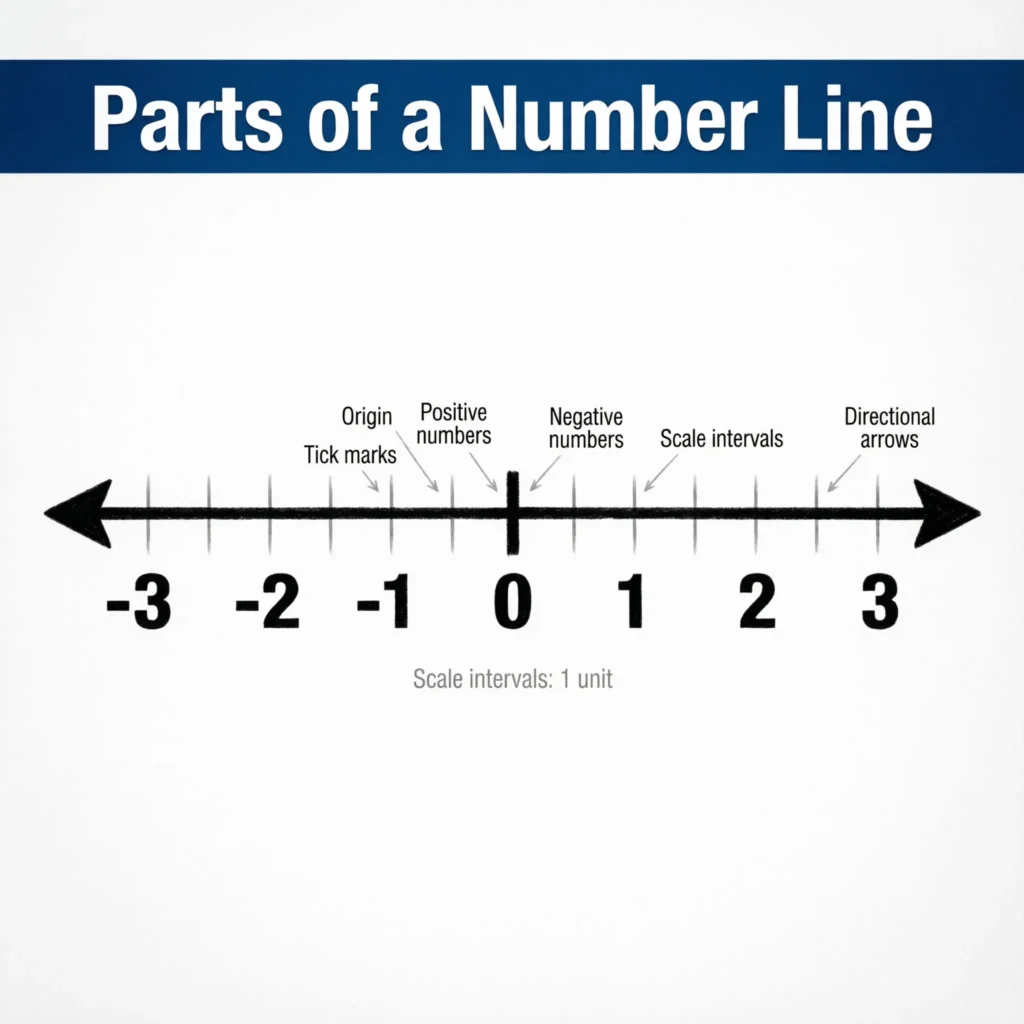
- 📏 The straight line is the main part.
- 📍 Points mark positions.
- 🔢 Numbers identify positions.
- 0️⃣ Zero is an important reference point.
- ➕ Positive numbers appear to the right.
- ➖ Negative numbers appear to the left.
- ↔️ Equal spaces show equal intervals.
- ➡️ The right direction represents greater values.
- ⬅️ The left direction represents smaller values.
- 🏷️ Labels identify values.
- 📐 Tick marks can show intervals.
- 🎯 Arrows can show the line continues.
- 📊 A scale tells how much each space represents.
- ⭐ Together, these parts make the line easy to read.
The most important idea is that position has meaning. A number farther to the right has a greater value than a number farther to the left.
Once these parts are clear, reading a number line becomes much easier.
Positive and Negative Numbers on a Number Line
A number line makes positive and negative numbers easier to understand. Zero separates the two groups.
- ➕ Positive numbers are greater than zero.
- ➖ Negative numbers are less than zero.
- 0️⃣ Zero is neither positive nor negative.
- ➡️ Positive values move right.
- ⬅️ Negative values move left.
- 🔢 1 is greater than 0.
- 🔢 2 is greater than 1.
- 🔢 -1 is less than 0.
- 🔢 -2 is less than -1.
- 📍 Distance from zero shows magnitude.
- 🧊 Temperature can use negative numbers.
- 🏢 Floors below ground can use negative values.
- 📊 Positive and negative values appear in data.
- 🧮 Number lines help compare them.
- ⭐ Direction is important when working with signed numbers.
For example, 3 is greater than -3 because 3 is located farther to the right on the number line.
Understanding this left-and-right relationship is one of the foundations of integer math.
Number Line for Addition
A number line can make addition simple and visual. Start at the first number and move to the right when adding a positive number.
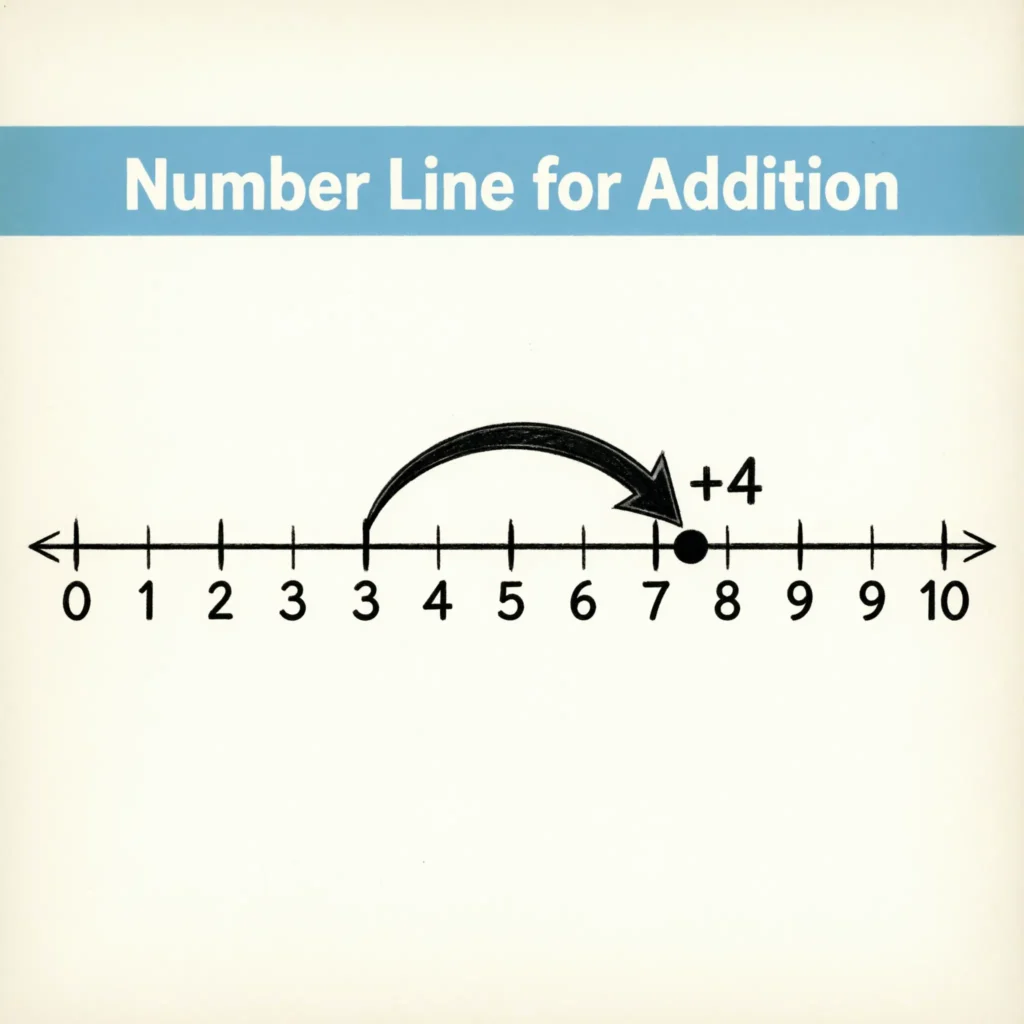
- ➕ Addition means combining values.
- 📍 Start at the first number.
- ➡️ Move right for positive addition.
- 🔢 Count one space at a time.
- 🎯 Stop at the answer.
- 🧮 2 + 3 means start at 2.
- ➡️ Move three spaces right.
- 🎯 You reach 5.
- 📚 This method helps beginners.
- ✏️ Teachers often use it in lessons.
- 🔎 It shows the meaning of addition.
- 📊 It works with small whole numbers.
- 📍 Starting position matters.
- 🧠 Visual movement supports understanding.
- ⭐ Practice makes the process faster.
For example, to solve 4 + 2, start at 4 and move two spaces to the right. You land on 6.
This visual method helps students connect addition with movement.
Number Line for Subtraction
Subtraction can also be shown with movement. When subtracting a positive number, move to the left.
- ➖ Subtraction means taking away.
- 📍 Start at the first number.
- ⬅️ Move left when subtracting a positive number.
- 🔢 Count the required spaces.
- 🎯 Stop at the answer.
- 🧮 7 – 3 starts at 7.
- ⬅️ Move three spaces left.
- 🎯 You reach 4.
- 📚 It helps students understand subtraction.
- ✏️ It can support mental math.
- 🔎 Direction is important.
- 📊 It gives a visual explanation.
- 🧮 Large numbers may need a larger scale.
- 🧠 Movement makes the operation easier to picture.
- ⭐ It is useful for beginner math.
For example, 8 – 5 means start at 8 and move five spaces left. The answer is 3.
Number lines can therefore turn subtraction into a simple movement problem.
Number Line for Fractions
A number line is a useful way to understand fractions because it shows exactly where a fraction lies between whole numbers.
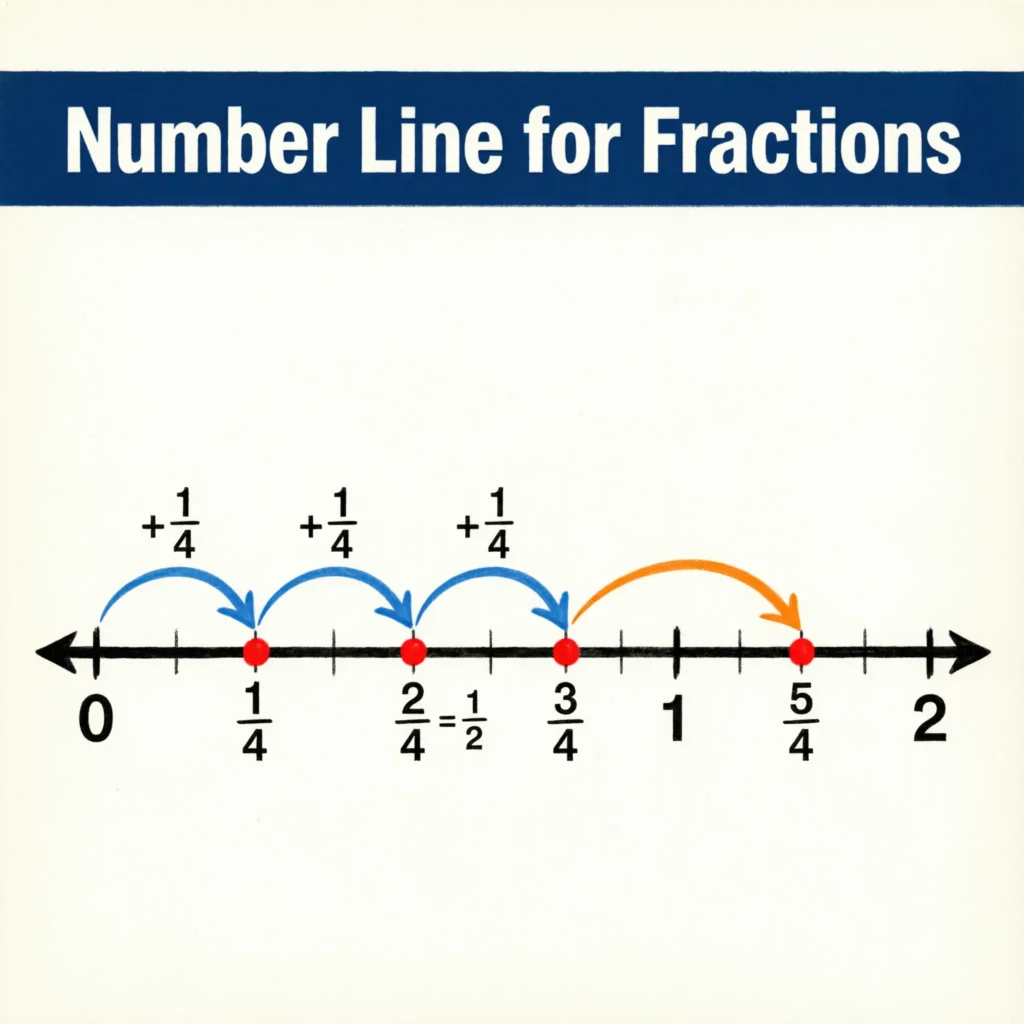
- 🥧 Fractions represent parts of a whole.
- 📏 Divide an interval into equal parts.
- 🔢 The denominator tells the number of parts.
- 📍 The numerator tells how many parts to count.
- ½ lies halfway between 0 and 1.
- ¼ lies one quarter of the way from 0 to 1.
- ¾ lies three quarters of the way from 0 to 1.
- ➡️ Larger positive fractions move right.
- ⬅️ Negative fractions move left.
- 🔎 Equivalent fractions can share the same position.
- 📚 Number lines help explain fraction size.
- ✏️ Students can use them in exams.
- 🎯 Equal spacing is important.
- ⭐ They make fractions less confusing.
For example, divide the space between 0 and 1 into four equal sections. The fourth mark represents 1/4, while the third represents 3/4.
This helps students see that fractions are numbers with specific positions.
Number Line for Decimals
Decimals can be placed between whole numbers on a number line. The scale determines how precisely the values can be shown.
- 🔢 Decimals can lie between whole numbers.
- 📍 0.5 is halfway between 0 and 1.
- 📍 0.25 is one quarter from 0 to 1.
- 📍 1.5 lies between 1 and 2.
- 📏 Equal intervals create a useful scale.
- 🔎 Tenths divide an interval into ten parts.
- 🔎 Hundredths create smaller sections.
- ➡️ Larger positive decimals move right.
- ⬅️ Smaller decimals move left.
- 📊 Money uses decimal values.
- 🌡️ Temperature often uses decimals.
- 📏 Measurements can use decimals.
- 📚 Students use decimal number lines.
- ✏️ They help explain place value.
- ⭐ They make decimal size easier to see.
For example, 0.7 is greater than 0.4 because 0.7 appears farther to the right.
A number line can make decimal comparison much clearer than looking at the digits alone.
Number Line for Integers
Integers include positive whole numbers, negative whole numbers, and zero. A number line provides a clear way to organize them.
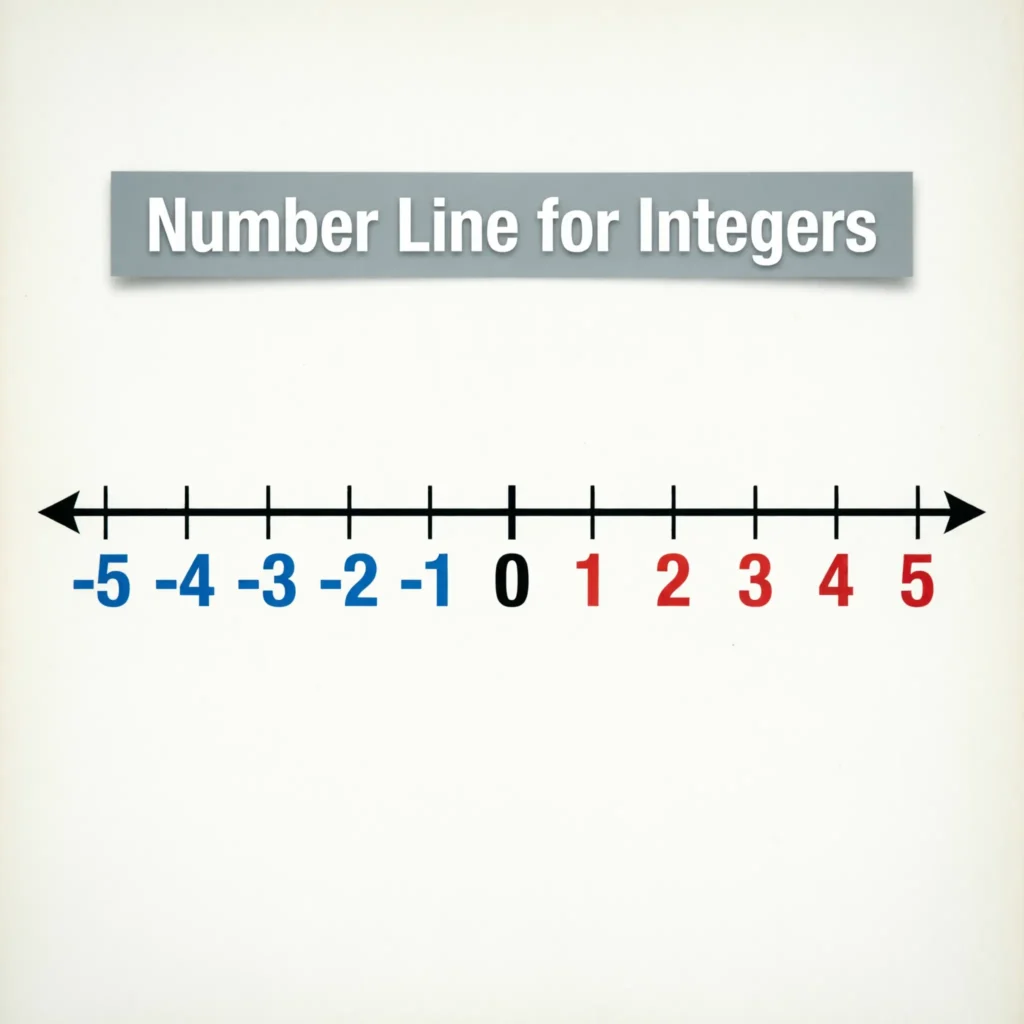
- 🔢 Integers include whole numbers.
- ➕ Positive integers are greater than zero.
- ➖ Negative integers are less than zero.
- 0️⃣ Zero is an integer.
- ➡️ Positive integers move right.
- ⬅️ Negative integers move left.
- 📍 Each integer has a fixed position.
- 📏 Consecutive integers have equal spacing.
- 📚 Integer lessons often use number lines.
- 🧊 Temperature can involve integers.
- 🏢 Elevation can involve integers.
- 💰 Financial changes can use positive and negative values.
- ⭐ Number lines make integer rules more visual.
For example, -4 is less than -2 because -4 is farther to the left.
This is one of the easiest ways for students to understand why negative numbers work differently from positive numbers.
Open and Closed Number Lines
Number lines can also be used to represent mathematical conditions, including inequalities. Open and closed circles have different meanings.
- < means less than.
- > means greater than.
- ≤ means less than or equal to.
- ≥ means greater than or equal to.
- ➡️ Shading right can represent greater values.
- ⬅️ Shading left can represent smaller values.
- 📍 The endpoint identifies the boundary.
- 📚 Students use this in algebra.
- ✏️ It helps explain solution sets.
- 🔎 The symbol and graph should agree.
- 📊 Arrows show that values continue.
- ⭐ This method makes inequalities easier to understand.
Number Line for Comparing Numbers
A number line makes number comparison simple. The position of a number tells you whether it is greater or smaller than another value.
- 🔎 Compare the positions of two numbers.
- ➡️ The number farther right is greater.
- ⬅️ The number farther left is smaller.
- 0️⃣ Zero provides a useful reference.
- ➕ Positive numbers are greater than negative numbers.
- 🔢 7 is greater than 4.
- 🔢 -2 is greater than -5.
- 📍 Equal positions represent equal values.
- ➖ Negative values require careful attention.
- 📊 Visual comparison reduces confusion.
- 📚 It is useful for students.
- ✏️ It can support exam questions.
- 🎯 It helps explain greater-than and less-than signs.
- ⭐ Position provides a quick answer.
For example, -1 > -4 because -1 appears to the right of -4.
Remember: with negative numbers, the number closer to zero is usually the greater number.
Types of Number Lines
Different number lines can be used for different mathematical purposes. The scale and values depend on the problem.
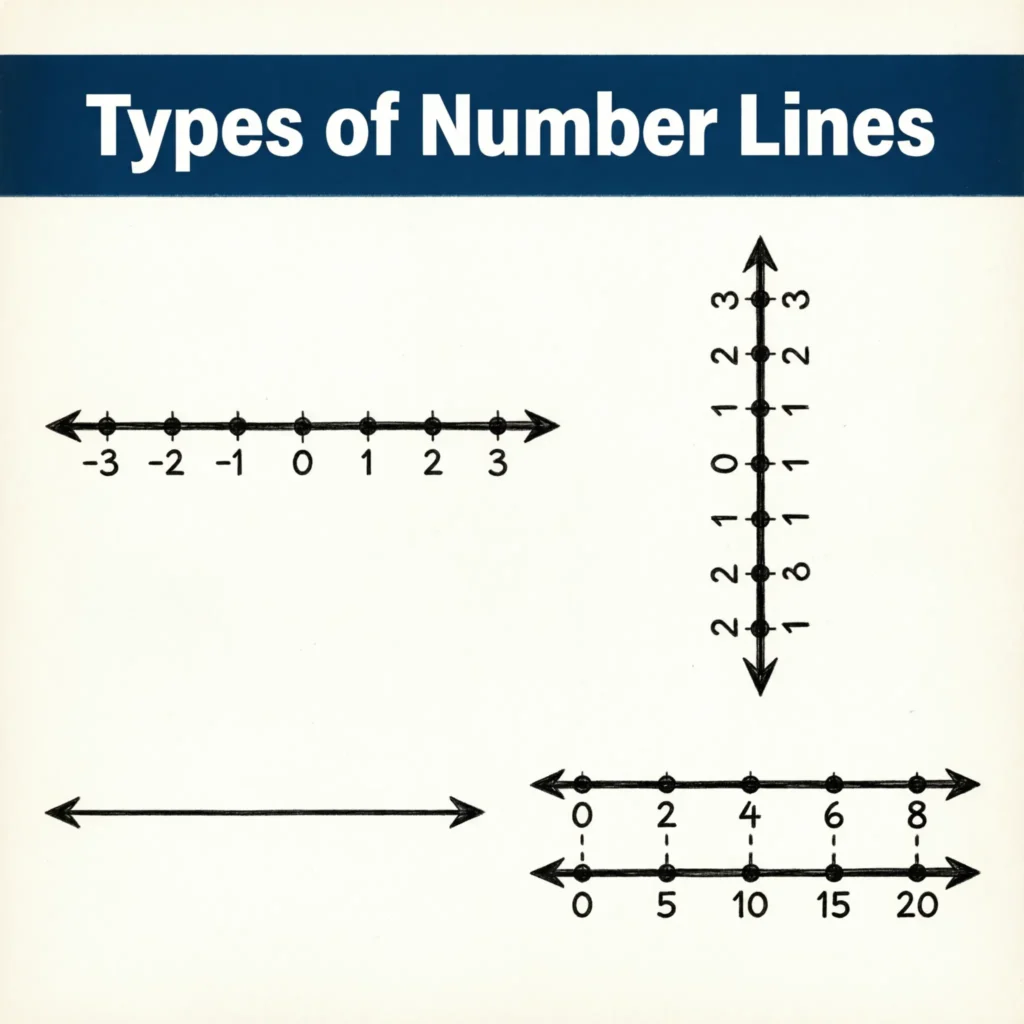
- 🔢 Whole-number number line shows whole values.
- ➖ Negative number line focuses on values below zero.
- 🧮 Integer number line includes negative and positive integers.
- 🥧 Fraction number line shows fractional values.
- 🔢 Decimal number line shows decimal values.
- 📊 Double number line compares two related quantities.
- 📐 Coordinate number line represents one dimension.
- 📈 Inequality number line shows solution sets.
- 🕐 Timeline can act like an ordered number line.
- 📏 Measurement line can represent distances.
- 🎯 Blank number line allows students to add values.
- 🧠 Mental number line supports quick calculations.
- 📚 Classroom number line supports teaching.
- ⭐ The best type depends on the math task.
The key difference between these types is the kind of values or relationships they are designed to display.
Double Number Line
A double number line places two related sets of values on parallel lines. It is especially useful for ratios, rates, percentages, and proportional relationships.
- 📊 Two number lines are used together.
- 🔢 Each line represents a related quantity.
- 📏 Equal intervals should match correctly.
- 🧮 Ratios can be displayed.
- 🚗 Distance and time can be compared.
- 🍎 Items and costs can be compared.
- 📚 Students use double number lines in math.
- 🎯 Proportional relationships become clearer.
- 🔎 Equivalent ratios can be identified.
- 📈 Values can increase together.
- ➡️ Corresponding points can be matched.
- 📊 Percent problems can use them.
- ✏️ They support visual problem-solving.
- ⭐ They are useful for ratio reasoning.
This makes relationships between two quantities easier to understand.
Number Line in Real Life
Number lines are not limited to school mathematics. The same idea appears whenever values are arranged from smaller to larger.
- 🌡️ Thermometers show temperature scales.
- 💰 Money values can be ordered.
- 📏 Rulers show measurement positions.
- 🏢 Building floors can show elevation.
- 🕐 Time moves in an ordered sequence.
- 📅 Dates can be placed in order.
- 📊 Test scores can be ranked.
- 💳 Account balances can include positive and negative values.
- 🌍 Elevation can rise above or below sea level.
- 📚 Progress can be tracked.
- 🎯 Targets can be marked.
- 💻 Digital dashboards can display scales.
Learning number lines therefore gives students a useful skill for both school and everyday decision-making.
How to Draw a Number Line
Drawing a number line is easy when you follow a few simple steps. The most important rule is to keep the scale consistent.
- ✏️ Draw a straight horizontal line.
- ➡️ Add arrows at the ends if needed.
- 📍 Mark evenly spaced points.
- 🔢 Choose the numbers to display.
- 0️⃣ Mark zero when appropriate.
- ➕ Add positive numbers to the right.
- ➖ Add negative numbers to the left.
- 📏 Keep intervals equal.
- 🏷️ Label important points.
- 🧮 Add fractions when needed.
- 🔢 Add decimals when needed.
- 🎯 Mark the requested value.
- 🔎 Check the scale.
- 📊 Make sure labels are readable.
- ✏️ Use a ruler for neat work.
- ⭐ Review the final line before using it.
A consistent scale is essential. If each space represents 1, do not suddenly make another space represent 5 without clearly changing the scale.
Number Line FAQs
- ❓ What is a number line? A number line is a straight line that shows numbers in their correct order and position.
- 🔢 Which way do numbers increase? Numbers increase as you move from left to right.
- ⬅️ Which way do numbers decrease? Numbers decrease as you move from right to left.
- 0️⃣ Where is zero on a number line? Zero is commonly used as the central reference point.
- ➕ Where are positive numbers? Positive numbers are normally placed to the right of zero.
- ➖ Where are negative numbers? Negative numbers are normally placed to the left of zero.
- 🧮 Can you use a number line for addition? Yes. Adding a positive number can be shown by moving right.
- ➖ Can you use a number line for subtraction? Yes. Subtracting a positive number can be shown by moving left.
- 🥧 Can fractions go on a number line? Yes. Fractions can be placed between whole numbers using equal intervals.
- 🔢 Can decimals go on a number line? Yes. Decimals can be placed between whole numbers according to their values.
- 📊 What is a double number line? It uses two related number lines to compare quantities, such as ratios or prices.
- ⚪ What does an open circle mean? In an inequality graph, it usually means the endpoint is not included.
- 🔵 What does a closed circle mean? It usually means the endpoint is included.
- 📈 Which number is greater on a number line? The number farther to the right is greater.
- 🧠 Why are number lines useful? They turn number relationships and operations into something students can see.
- ⭐ Are number lines useful in 2026? Yes. They remain an important math-learning tool in classrooms, digital learning platforms, and educational resources.
Conclusion:
A number line is one of the simplest and most useful tools in mathematics. It helps students understand number order, positive and negative numbers, integers, fractions, decimals, addition, subtraction, comparison, and inequalities.
The main rule is easy to remember: numbers become greater as you move right and smaller as you move left. Once students understand this idea, many math problems become easier to visualize and solve.
In 2026, number lines remain valuable in traditional classrooms as well as digital learning tools. Whether you are studying basic arithmetic or preparing for more advanced algebra, learning to read and use a number line is an important foundation.

Natalie Carter writes emotional and uplifting lines about relationships, happiness, confidence, and everyday experiences.