

The Hammersmith and City line is one of the London Underground lines serving west, central, and east London. It is shown in pink on the Tube map and provides a useful route between Hammersmith and Barking, with trains passing important areas such as Paddington, Baker Street, King’s Cross St Pancras, Farringdon, Liverpool Street, and Whitechapel. TfL’s current timetable lists the route from Hammersmith through central London and onward toward Barking. (Transport for London)
In 2026, the line remains useful for commuters, students, tourists, airport connections, and people travelling across London. This guide explains the Hammersmith and City line route, stations, map, timetable, connections, history, accessibility, and travel tips in simple language.
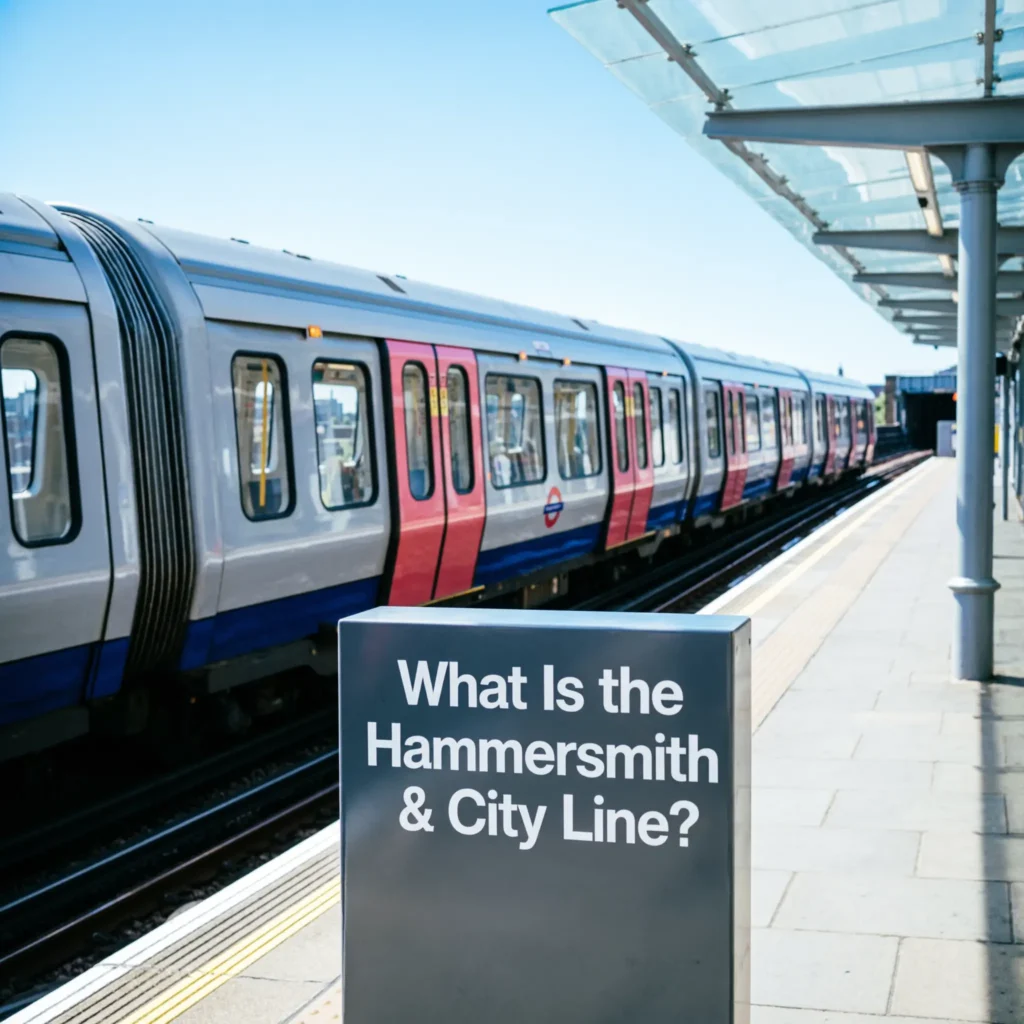
What Is the Hammersmith and City Line?
The Hammersmith and City line is a London Underground route connecting west London with central and east London. It shares parts of its route with the Circle and Metropolitan lines, making it useful for many different journeys.
- 🚇 It is a London Underground line.
- 🩷 It is shown in pink on Tube maps.
- 📍 It serves west London.
- 🏙️ It travels through central London.
- 🌆 It continues toward east London.
- 🚉 Hammersmith is one end of the route.
- 🚉 Barking is an important eastern destination.
- 🚆 Some services also interact with Circle line routes.
- 📍 Paddington is on the route.
- 📍 Baker Street is on the route.
- 📍 Farringdon is on the route.
- 📍 Liverpool Street is on the route.
- 📍 Whitechapel is on the route.
- 🧭 It provides cross-London connections.
- 📱 TfL provides current service information.
- ⭐ It is an important part of London’s transport network.
The line is especially useful because it passes through several major interchange stations.
Hammersmith and City Line Route
The Hammersmith and City line travels across London from Hammersmith toward Barking. The route includes many stations shared with or connected to other Underground services.
- 🚇 Hammersmith is the western end.
- 🩷 Goldhawk Road comes next.
- 🚉 Shepherd’s Bush Market is on the route.
- 🚉 Wood Lane is served by the line.
- 🚉 Latimer Road follows.
- 🚉 Ladbroke Grove is included.
- 🚉 Westbourne Park is on the route.
- 🚉 Royal Oak is served.
- 🚉 Paddington provides major connections.
- 🚉 Edgware Road is on the route.
- 🚉 Baker Street is a major interchange.
- 🚉 King’s Cross St Pancras is another key station.
- 🚉 Farringdon connects with the Elizabeth line.
- 🚉 Liverpool Street provides many connections.
- 🚉 Whitechapel connects with the Elizabeth line.
- 🚉 The route continues east toward Barking.
TfL’s published timetable lists these stations in sequence from Bromley-by-Bow through central London to Hammersmith, confirming the line’s wide cross-London coverage. (Transport for London)
Hammersmith and City Line Stations
The line has a long list of stations connecting different parts of London. Knowing the station names makes planning a journey much easier.
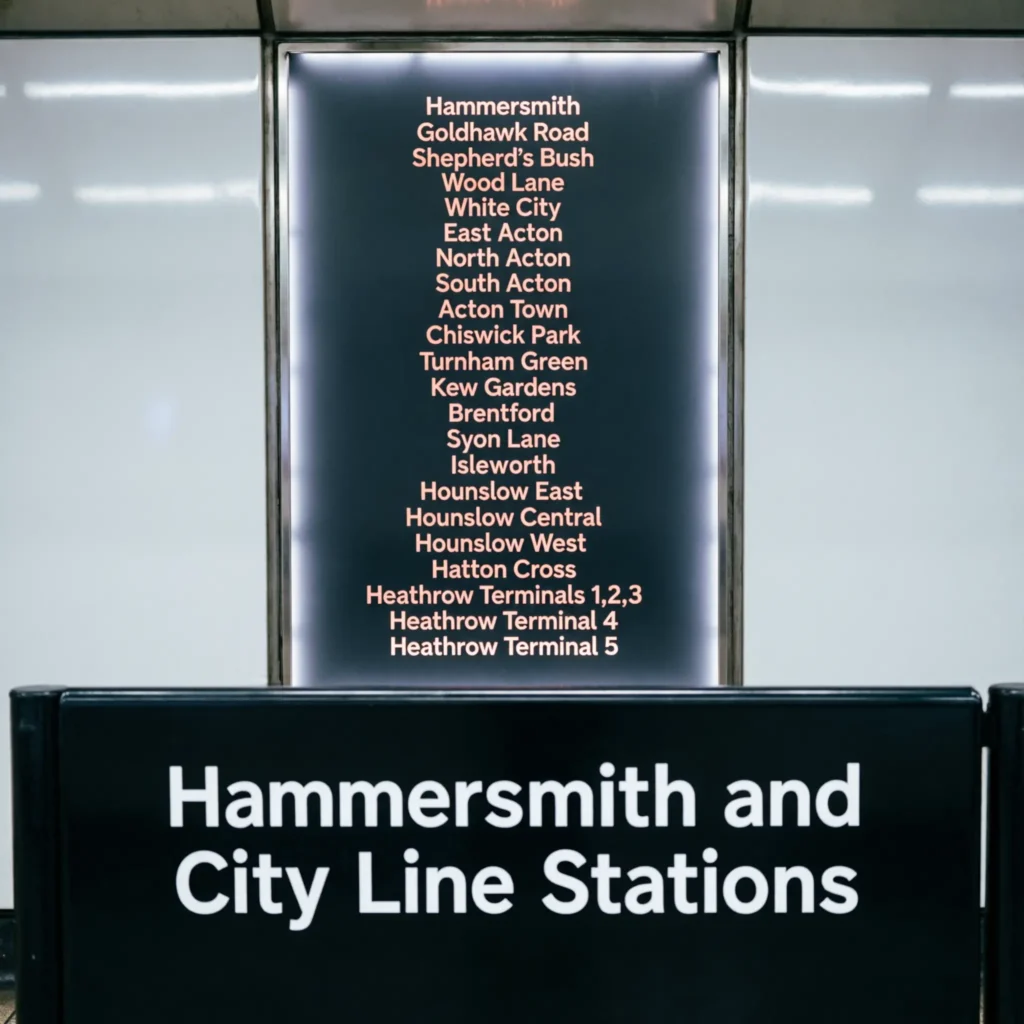
- 🚉 Hammersmith
- 🚉 Goldhawk Road
- 🚉 Shepherd’s Bush Market
- 🚉 Wood Lane
- 🚉 Latimer Road
- 🚉 Ladbroke Grove
- 🚉 Westbourne Park
- 🚉 Royal Oak
- 🚉 Paddington
- 🚉 Edgware Road
- 🚉 Baker Street
- 🚉 Great Portland Street
- 🚉 Euston Square
- 🚉 King’s Cross St Pancras
- 🚉 Farringdon
- 🚉 Liverpool Street
- 🚉 Whitechapel
After Whitechapel, eastbound services continue through stations including Aldgate East, Stepney Green, Mile End, Bow Road, Bromley-by-Bow, and toward Barking. (Transport for London)
Hammersmith and City Line Map
The Hammersmith and City line map shows how the route crosses London from west to east. It also helps passengers identify interchange stations and nearby Tube lines.
- 🗺️ The line appears in pink.
- 🚇 Hammersmith is toward the west.
- 🚉 Barking is toward the east.
- 📍 Paddington is an important interchange.
- 📍 Baker Street connects with several lines.
- 📍 King’s Cross St Pancras is a major transport hub.
- 📍 Farringdon connects with the Elizabeth line.
- 📍 Liverpool Street has several connections.
- 📍 Whitechapel connects with the Elizabeth line.
- 🔵 Circle line services share parts of the route.
- 🟣 Metropolitan line services share central sections.
- 🚇 District line connections appear at several stations.
- 🚆 National Rail connections are available at major stations.
- 🧭 The map helps with route planning.
- 📱 Digital maps can provide live travel information.
- ⭐ Check the latest TfL map before travelling.
TfL’s station information confirms connections between the Hammersmith and City line and other Tube and rail services at stations such as Farringdon, Paddington, and King’s Cross St Pancras. (Transport for London)
Hammersmith and City Line Timetable
The Hammersmith and City line timetable provides scheduled departure and arrival information. Exact times can change, so passengers should check TfL before making a journey.
- 🕐 Timetables show scheduled services.
- 🚇 Trains operate in both directions.
- 🩷 Services run between west and east London.
- 📱 TfL publishes timetable information.
- 🚉 Individual stations have their own schedules.
- 📅 Weekday and weekend services can differ.
- 🛠️ Engineering work can change services.
- ⚠️ Delays can affect actual arrival times.
- 🔎 Check the timetable for your station.
- 🧭 Confirm the direction of travel.
- 🚆 Check the train destination.
- 📢 Listen for station announcements.
- 📱 Use live journey information when possible.
- 🕐 Allow extra time during busy periods.
- 🗺️ Plan connections before starting a journey.
- ⭐ A live status check is better than relying only on an old timetable.
TfL publishes first and last train information and route timetables for the line. (Transport for London)
Hammersmith and City Line Status
The line’s status can change because of delays, maintenance, station problems, or other events. Checking live information is important before travelling.
- 🚇 Service status can change during the day.
- 📱 TfL provides live status information.
- ⚠️ Delays can happen unexpectedly.
- 🛠️ Planned engineering work can affect services.
- 🚉 Individual stations can have restrictions.
- 📢 Staff announcements provide updates.
- 🕐 Live arrival information shows approaching trains.
- 🔎 Check before leaving home.
- 🧭 Check both departure and destination stations.
- 🚆 Look at alternative routes if necessary.
- 📱 Digital journey planners can help.
- 🚌 Buses may provide alternatives during disruptions.
- 🚉 Major interchanges can become busy.
- ⏰ Allow extra time when disruption is reported.
- 🔄 Refresh status information before travelling.
- ⭐ Current TfL information is the best source for live conditions.
For example, TfL station pages provide live arrivals and line status, including service information for the Hammersmith and City line. (Transport for London)
Hammersmith and City Line to Paddington
Paddington is one of the most useful stations on the Hammersmith and City line. It provides connections to several other transport services.
- 🚉 Paddington is on the Hammersmith and City line.
- 🚇 Bakerloo services connect nearby.
- 🔵 Circle line services are available.
- 🟢 District line services are available.
- 🟣 Elizabeth line services are available.
- 🚆 National Rail services operate at Paddington.
- ✈️ It is useful for Heathrow journeys.
- 🧳 Tourists often use the station.
- 🏨 Many hotels are nearby.
- 🗺️ It is an important interchange.
- 📱 Check live departures.
- 🕐 Allow time for changing trains.
- 🚶 Station walking distances can vary.
- 📢 Follow platform signs.
- 🔎 Check the correct direction.
- ⭐ Paddington is one of the line’s key stations.
TfL lists connections between Paddington and the Elizabeth, Bakerloo, Circle, and District lines. (Transport for London)
Hammersmith and City Line to Baker Street
Baker Street is another major interchange on the route. It is useful for connections to several Underground lines and attractions in the surrounding area.
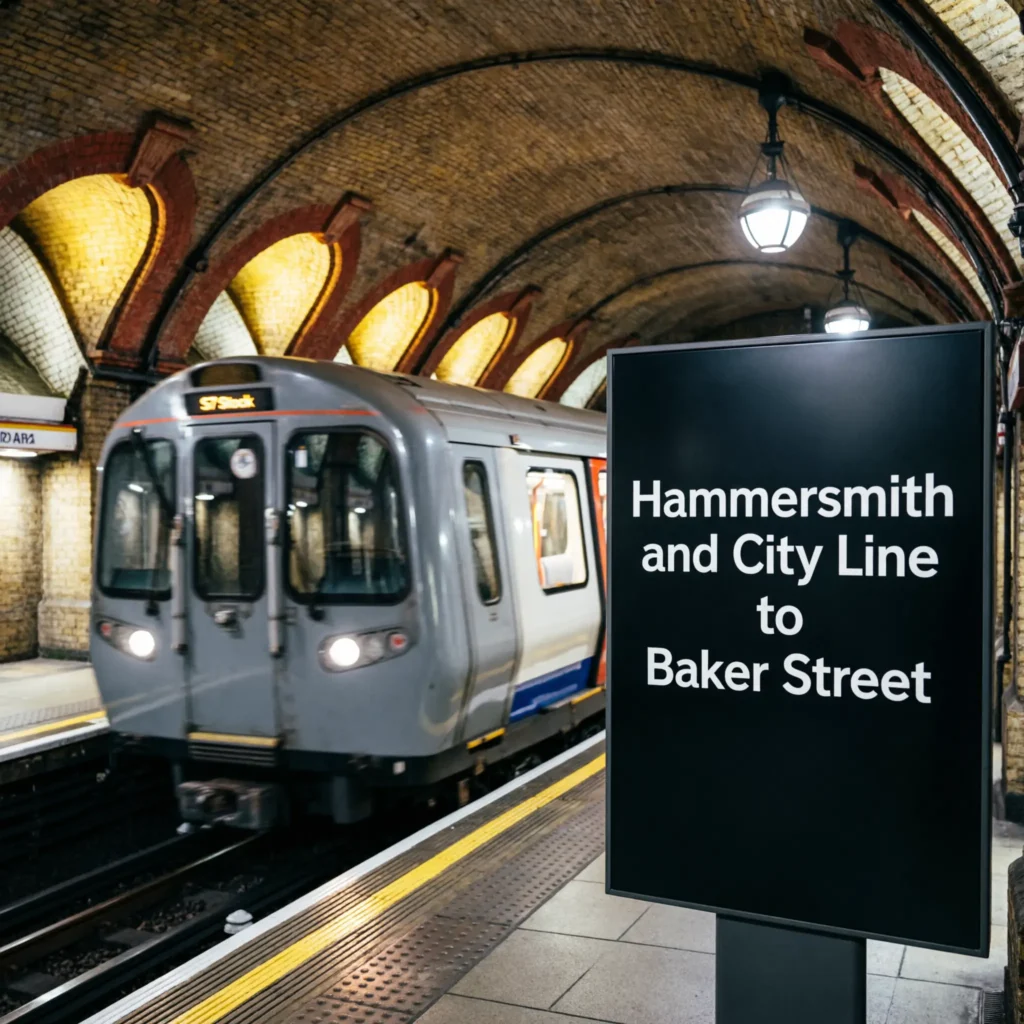
- 🚉 Baker Street is on the line.
- 🚇 Bakerloo line connects here.
- 🩷 Hammersmith and City services stop here.
- 🔵 Circle line services stop here.
- 🟣 Metropolitan line services stop here.
- 🎟️ It is close to Madame Tussauds.
- 🌳 Regent’s Park is nearby.
- 🏙️ Marylebone is close to the station.
- 📍 It is useful for central London journeys.
- 🚆 Several routes meet here.
- 🧭 Check platform signs carefully.
- 📱 Live arrivals can help.
- 🕐 Busy periods can be crowded.
- 🚶 Allow time for interchange.
- 🔎 Check the direction of your train.
- ⭐ Baker Street is a major Tube interchange.
Hammersmith and City Line to Farringdon
Farringdon is one of the most important modern interchange points on the route. It connects the Hammersmith and City line with other Tube and rail services, including the Elizabeth line.
- 🚉 Farringdon is served by the line.
- 🔵 Circle line services connect here.
- 🟣 Metropolitan line services connect here.
- 🟣 Elizabeth line services connect here.
- 🚆 National Rail services are available.
- 🏙️ It serves central London.
- 💼 It is useful for City journeys.
- 📍 The station is in central London.
- 🚉 Barbican is nearby.
- 🏢 Many offices are in the area.
- 📱 Check live arrivals.
- 🧭 Plan connections carefully.
- 🚶 Interchange routes can involve walking.
- 📢 Follow station signs.
- 🕐 Allow extra time during busy periods.
- ⭐ Farringdon is a major transport hub.
TfL confirms that Farringdon connects the Hammersmith and City line with the Circle, Metropolitan, Elizabeth line, and National Rail services. (Transport for London)
Hammersmith and City Line to Liverpool Street
Liverpool Street is another important station for commuters and visitors. It provides access to central London’s financial district and several transport connections.
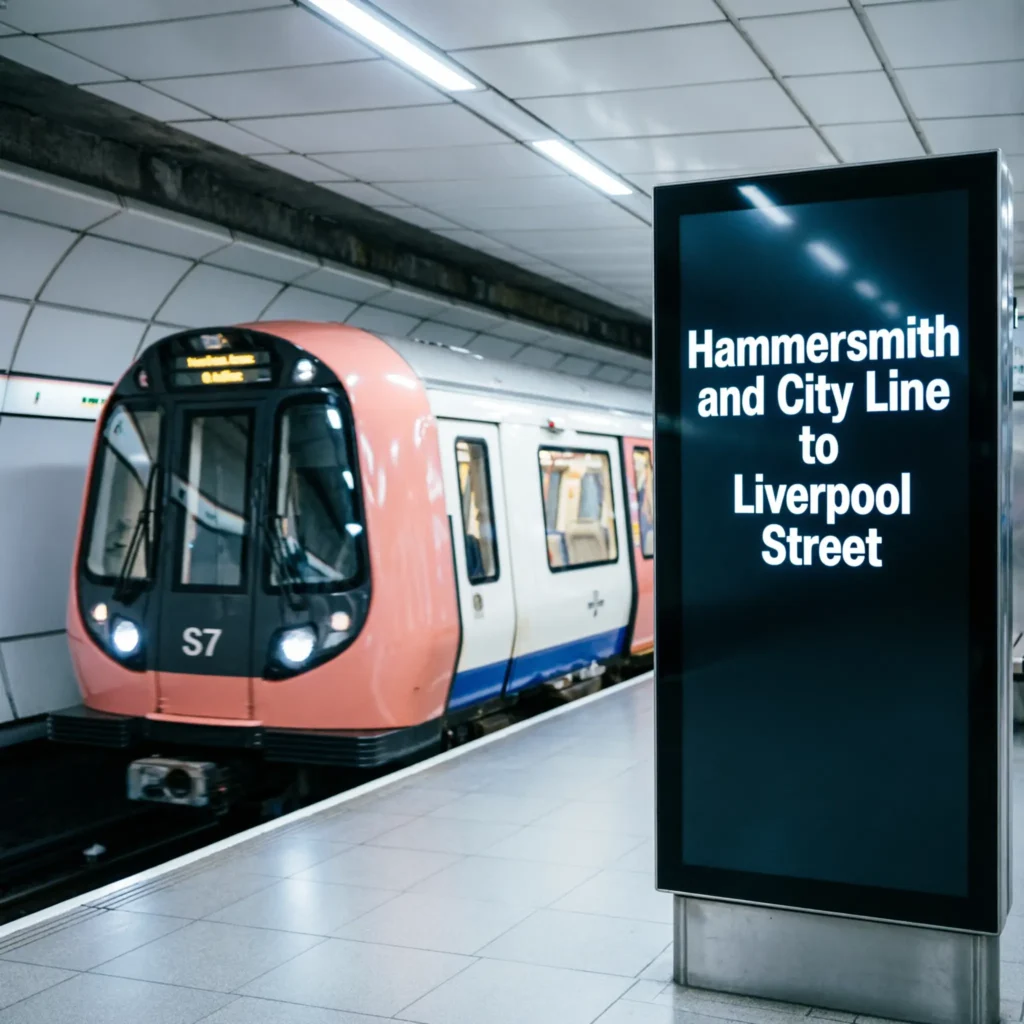
- 🚉 Liverpool Street is on the route.
- 🚇 Central line services connect here.
- 🔵 Circle line services connect here.
- 🟣 Metropolitan line services connect here.
- 🟣 Elizabeth line services connect here.
- 🚆 National Rail services are available.
- 🚉 London Overground connections are nearby.
- 💼 The City of London is nearby.
- 🏙️ It is useful for business travel.
- 🛍️ Spitalfields is nearby.
- 🚆 Rail connections extend beyond London.
- 📱 Check live departure information.
- 🕐 The station can be busy at peak times.
- 🧭 Check the correct platform.
- 🔎 Plan interchange time.
- ⭐ Liverpool Street is a key central London station.
TfL’s timetable identifies Liverpool Street as a connection point for the Central, Circle, Metropolitan, Elizabeth line, National Rail, and London Overground. (Transport for London)
Hammersmith and City Line to Whitechapel
Whitechapel is an important east London station where passengers can connect with several services.
- 🚉 Whitechapel is on the Hammersmith and City line.
- 🟢 District line services connect here.
- 🟣 Elizabeth line services connect here.
- 🚆 London Overground services connect here.
- 🏙️ It serves east London.
- 🏥 The Royal London Hospital is nearby.
- 📍 The area has strong transport links.
- 🚇 Several lines meet here.
- 📱 Live arrivals are useful.
- 🕐 Check service information before travelling.
- 🧭 Confirm the train direction.
- 🚶 Allow time when changing services.
- 🗺️ Use the Tube map to plan connections.
- 📢 Follow station signs.
- 🔎 Check for engineering work.
- ⭐ Whitechapel is an important east London interchange.
TfL’s timetable lists Whitechapel as a connection with the District line, Elizabeth line, and London Overground. (Transport for London)
Hammersmith and City Line Connections
One of the biggest advantages of this route is the number of connections available. Passengers can change to other Tube, rail, and transport services at several stations.
- 🔵 Circle line connections are available.
- 🟢 District line connections are available.
- 🟣 Metropolitan line connections are available.
- 🔴 Central line connects at Liverpool Street.
- 🔵 Piccadilly line connects at King’s Cross St Pancras.
- 🟠 Northern line connects at King’s Cross St Pancras.
- 🟣 Victoria line connects at King’s Cross St Pancras.
- 🟤 Bakerloo line connects at Baker Street and Paddington.
- 🟣 Jubilee line connects at Baker Street.
- 🟣 Elizabeth line connects at Paddington.
- 🟣 Elizabeth line connects at Farringdon.
- 🟣 Elizabeth line connects at Liverpool Street.
- 🟣 Elizabeth line connects at Whitechapel.
- 🚆 National Rail connects at several major stations.
- 🗺️ Interchanges make cross-London journeys easier.
- ⭐ Planning connections can save travel time.
The exact interchange route can involve walking within stations, so passengers should follow current TfL signs.
Hammersmith and City Line History
The Hammersmith and City line has a long history within London’s railway system. Its route is closely connected with the development of the Metropolitan Railway and London’s early underground rail network.
- 🕰️ It has deep roots in London’s railway history.
- 🚇 It forms part of the oldest Underground network.
- 🚆 Early sections helped connect west and central London.
- 🏙️ The route developed as London expanded.
- 🚉 Stations became important local transport points.
- 🩷 The line now has a distinctive pink map colour.
- 🔵 It shares infrastructure with the Circle line.
- 🟣 It also interacts with the Metropolitan line.
- 🏗️ Railway development changed London travel.
- 📚 Its history is important to transport studies.
- 🏙️ Many historic areas lie along the route.
- 🚆 Modern trains replaced older rolling stock.
- 📱 Digital information now supports passengers.
- 🗺️ Modern maps simplify complex railway history.
- ⭐ The line remains an important London route.
- 🚇 Its history reflects the growth of the capital.
Its historical importance is one reason the route is often included in discussions about the development of London’s Underground system.
Hammersmith and City Line Accessibility
Accessibility is an important part of modern public transport. TfL provides station accessibility information to help passengers plan journeys.
- ♿ Some stations have step-free facilities.
- 🛗 Lifts are available at selected stations.
- 🚉 Accessibility differs between stations.
- 📱 TfL provides accessibility information.
- 🧭 Plan the complete journey.
- 🚶 Check interchange routes.
- 🛗 Check whether lifts are working.
- 📢 Staff can provide assistance.
- 🔎 Check the official accessibility guide.
- 🚆 Train and platform access can vary.
- 🏙️ Major stations can have complex layouts.
- 📱 Live station information can be useful.
- 🧳 Allow extra time when changing trains.
- ♿ Accessibility needs should be considered before travel.
- 🗺️ Route planning can identify suitable stations.
- ⭐ Check current information before travelling.
TfL station pages provide accessibility information and links to its step-free Tube guidance. (Transport for London)
Hammersmith and City Line in 2026
In 2026, the Hammersmith and City line continues to support daily travel across London. Modern travel planning increasingly combines live transport information with digital journey tools.
- 📱 Live status information helps passengers plan.
- 🗺️ Digital maps make routes easier to understand.
- 🚆 Real-time arrivals can reduce waiting uncertainty.
- 🛠️ Planned works can be checked before travel.
- ♿ Accessibility information is available online.
- 🧭 Journey planners can suggest alternatives.
- 🚉 Major interchange stations remain important.
- 🌆 Cross-London travel continues to be a major use.
- 💼 Commuters use the route every day.
- 🎓 Students use it to reach schools and universities.
- 🧳 Tourists use central London stations.
- ✈️ Paddington provides airport connections.
- 📊 Live information supports better journey planning.
- 🔎 Current service information is more useful than old schedules.
- 🌐 Digital transport tools are increasingly important.
- ⭐ The basic route remains a key part of London’s network.
The line’s role is especially valuable because it connects several major transport hubs across west, central, and east London.
Hammersmith and City Line FAQs
- ❓ What is the Hammersmith and City line? It is a London Underground line connecting Hammersmith in west London with destinations toward Barking in east London.
- 🩷 What colour is the Hammersmith and City line? It is shown in pink on the London Tube map.
- 🚉 Where does the Hammersmith and City line go? It travels through stations including Paddington, Baker Street, King’s Cross St Pancras, Farringdon, Liverpool Street, and Whitechapel before continuing east.
- 🚇 Does the Hammersmith and City line go to Paddington? Yes.
- 🚉 Does it stop at Baker Street? Yes.
- 🚉 Does it stop at King’s Cross St Pancras? Yes.
- 🚉 Does it stop at Farringdon? Yes, and Farringdon connects with the Elizabeth line and National Rail.
- 🚉 Does it stop at Liverpool Street? Yes.
- 🚉 Does it stop at Whitechapel? Yes.
- 🗺️ Where can I find the Hammersmith and City line map? The latest London Underground map from TfL provides the current route.
- 🕐 Where can I find the Hammersmith and City line timetable? TfL provides station-specific and line timetables.
- 🚦 Is the Hammersmith and City line running normally? Service status can change, so check current TfL information before travelling.
- 🚆 Does it connect with the Elizabeth line? Yes, connections are available at Paddington, Farringdon, Liverpool Street, and Whitechapel. (Transport for London)
- ♿ Is the Hammersmith and City line accessible? Accessibility varies by station, so check TfL’s current step-free and accessibility information.
- 📱 How can I check live Hammersmith and City line information? Use TfL’s official service-status and journey-planning information.
- ⭐ Why is the Hammersmith and City line important? It links west, central, and east London while providing connections to many major Tube and rail services.
Conclusion:
The Hammersmith and City line is an important London Underground route connecting Hammersmith, central London, and the eastern part of the capital. Its stations include major transport hubs such as Paddington, Baker Street, King’s Cross St Pancras, Farringdon, Liverpool Street, and Whitechapel. (Transport for London)
For 2026 travel, the best approach is to check the latest TfL status, timetable, station information, and planned works before setting off. Whether you are commuting, sightseeing, studying, or connecting to another railway service, understanding the route and its major interchanges can make your journey much easier.

Andrew Collins creates inspiring content centered around success, motivation, leadership, and positive thinking.