
The Mildmay line is one of the six named London Overground routes serving London. It connects Richmond and Clapham Junction with Stratford, linking west, north, and east London through a useful cross-city route. The line received its Mildmay name in 2024 as part of Transport for London’s project to give each London Overground route its own name and colour. (Made by TfL blog)
In 2026, the Mildmay line remains an important part of London’s public transport network. Its route includes places such as Richmond, Gunnersbury, Willesden Junction, West Hampstead, Highbury & Islington, Hackney Central, and Stratford. The current TfL timetable is valid from 17 May 2026 until further notice. (Transport for London)
What Is the Mildmay Line?
The Mildmay line is a London Overground route operated as part of Transport for London’s six-line Overground network. It provides services between Richmond and Clapham Junction in the west and Stratford in east London. The route passes through several important interchange points, making it useful for journeys that might otherwise require travelling through central London. (Transport for London)
- 🚆 It is part of London Overground.
- 🟠 The line has its own name and colour.
- 📍 It connects west and east London.
- 🚉 Richmond is one western terminus.
- 🚉 Clapham Junction is another western terminus.
- 🏙️ Stratford is the eastern terminus.
- 🔄 The route provides many interchange opportunities.
- 🚇 It connects with London Underground services.
- 🚆 It connects with National Rail at several stations.
- 🗺️ The route crosses several London areas.
- 🏘️ It serves residential communities.
- 🏢 It serves important employment areas.
- 🎓 It provides access to schools and colleges nearby.
- 🛍️ It supports shopping and leisure journeys.
- 📅 Timetables can change because of engineering work.
- 📱 TfL provides journey-planning information.
The Mildmay line is more than just a railway route. It connects different parts of London and makes cross-city travel easier. Its named identity also helps passengers understand the Overground network more clearly.
Mildmay Line Route in 2026
The Mildmay line runs between Richmond and Clapham Junction and Stratford. The route passes through western, northern, and eastern parts of London before reaching Stratford. TfL’s current timetable and route information confirm these destinations for the 2026 service. (Transport for London)
- 🚉 Richmond is a western terminus.
- 🚉 Clapham Junction is a western terminus.
- 🌳 Kew Gardens is on the route.
- 🚆 Gunnersbury provides interchange opportunities.
- 🏙️ Willesden Junction is an important connection.
- 🏘️ Kensal Rise is served.
- 🚉 Brondesbury Park is served.
- 🚉 Brondesbury is on the route.
- 🚇 West Hampstead provides connections.
- 🌲 Hampstead Heath is served.
- 🚉 Gospel Oak is an important interchange.
- 🚇 Highbury & Islington connects with other services.
- 🏘️ Hackney Central is on the route.
- 🚉 Hackney Wick is served.
- 🏟️ Stratford is the eastern terminus.
- 🗺️ The route crosses several London boroughs.
The route is especially useful because it avoids the need to travel into central London for many west-to-east journeys. Passengers can change to other rail and Underground services at several points along the way.
Mildmay Line Stations
The Mildmay line serves a long sequence of stations between its western branches and Stratford. The exact journey depends on whether you start from Richmond or Clapham Junction. TfL’s current route map shows the stations and connections along the Mildmay line. (Transport for London)
- 🚉 Richmond
- 🌿 Kew Gardens
- 🚆 Gunnersbury
- 🏙️ South Acton
- 🚉 Acton Central
- 🚆 Willesden Junction
- 🏘️ Kensal Rise
- 🚉 Brondesbury Park
- 🚉 Brondesbury
- 🚇 West Hampstead
- 🌲 Hampstead Heath
- 🚉 Gospel Oak
- 🚇 Kentish Town West
- 🚉 Camden Road
- 🚇 Highbury & Islington
- 🏙️ Stratford
The station list shows why the Mildmay line is useful for both local and longer journeys. It connects residential areas with major interchange stations and destinations across London.
Mildmay Line Connections
One of the strongest features of the Mildmay line is its connections with other transport services. Passengers can change to London Underground, other Overground routes, National Rail, and other transport options at several stations. Highbury & Islington, Willesden Junction, Gospel Oak, Stratford, and West Hampstead are particularly useful connection points. (Transport for London)
- 🔄 Highbury & Islington connects with the Victoria line.
- 🚇 Stratford connects with the Central line.
- 🚇 Stratford connects with the Jubilee line.
- 🚆 Stratford connects with National Rail.
- 🚇 West Hampstead connects with the Jubilee line nearby.
- 🚆 West Hampstead offers National Rail connections nearby.
- 🚇 Willesden Junction connects with other Overground services.
- 🚆 Gospel Oak connects with the Suffragette line.
- 🚇 Gunnersbury connects with District line services.
- 🚆 Richmond connects with National Rail.
- 🚇 Richmond connects with the District line.
- 🚉 Clapham Junction has many National Rail services.
- 🔄 Hackney Central connects with Hackney Downs nearby.
- 🗺️ Interchanges make cross-London travel easier.
- 📱 Journey planners can show available connections.
- ⏱️ Connection times can vary.
These connections make the Mildmay line valuable for passengers travelling between parts of London that are not directly connected by Underground lines. Checking the journey planner before travelling is useful when connections are important.
Mildmay Line and Stratford
Stratford is the eastern terminus of the Mildmay line and one of London’s major transport hubs. The station connects with multiple Underground, Elizabeth line, DLR, National Rail, and London Overground services. This makes Stratford an important destination for passengers using the Mildmay line from western and northern parts of London. (Transport for London)
- 🏙️ Stratford is the eastern terminus.
- 🚇 Central line services are available.
- 🚇 Jubilee line services are available.
- 🚆 National Rail services connect at Stratford.
- 🚆 Elizabeth line services serve Stratford.
- 🚈 DLR services serve the area.
- 🛍️ Westfield Stratford City is nearby.
- 🏟️ Queen Elizabeth Olympic Park is nearby.
- 🎓 Educational institutions are nearby.
- 🏢 Stratford is an important business area.
- 🏘️ The area has major residential developments.
- 🚉 The station is a major interchange.
- 🗺️ Many London journeys can be made from Stratford.
- 📱 TfL journey planning covers the station.
- 🚶 Walking connections link nearby destinations.
- 🌆 Stratford remains an important east London hub.
For many Mildmay line passengers, Stratford is more than an endpoint. It is a place to change trains, reach major attractions, or continue towards other parts of London.
Mildmay Line and Richmond
Richmond is one of the two western branches of the Mildmay line. It is also served by London Underground’s District line and National Rail services, giving passengers several options for continuing their journey. The combination makes Richmond an important western interchange for the Overground route. (Transport for London)
- 🌳 Richmond is the western terminus.
- 🚆 National Rail services operate from Richmond.
- 🚇 District line trains serve Richmond.
- 🌊 The River Thames is nearby.
- 🌳 Richmond Park is nearby.
- 🏘️ The area has historic streets.
- 🛍️ Richmond has shopping areas.
- 🎭 Local entertainment is available nearby.
- 🍽️ Restaurants and cafes are found around the town.
- 🚶 Walking routes connect many local attractions.
- 🏞️ Parks provide green space.
- 🚆 Mildmay trains connect Richmond with Stratford.
- 🔄 Passengers can change between rail services.
- 📱 TfL provides travel information.
- 🗺️ Richmond is useful for west London journeys.
- ⭐ It gives the Mildmay line an important western endpoint.
Richmond gives the Mildmay line a direct connection with an attractive and busy part of southwest London. From Richmond, passengers can continue on the Overground, Underground, or National Rail network.
Mildmay Line and Clapham Junction
Clapham Junction is the second western terminus of the Mildmay line. It is one of the UK’s busiest railway stations and provides extensive National Rail connections. The Mildmay service therefore gives passengers from Stratford and intermediate stations a useful connection to south and southwest London. (Transport for London)
- 🚉 Clapham Junction is a western terminus.
- 🚆 National Rail services connect in many directions.
- 🏙️ It serves southwest London.
- 🔄 Passengers can change trains there.
- 🚆 Mildmay trains continue toward Stratford.
- 🗺️ The station supports many commuter journeys.
- 🏘️ Clapham is nearby.
- 🌳 Local parks are accessible from the area.
- 🛍️ Shopping areas are nearby.
- 🍽️ Restaurants and cafes serve the local area.
- 🚶 Walking connections are available.
- 📱 Live departures can help with planning.
- ⏱️ Platform changes can occur.
- 🧳 The station handles many daily passengers.
- 🚉 National Rail connections expand travel options.
- ⭐ It is an important western endpoint for the Mildmay line.
The Clapham Junction branch makes the Mildmay line especially useful for passengers travelling between east London and destinations served by National Rail around southwest London.
Mildmay Line and Highbury & Islington
Highbury & Islington is one of the key interchange stations on the Mildmay line. The station connects the Mildmay route with the Victoria line and the Windrush line. This gives passengers useful options for reaching central and south London without travelling through the busiest central stations. (Transport for London)
- 🚉 Highbury & Islington is on the Mildmay line.
- 🚇 Victoria line services are available.
- 🚆 Windrush line services connect there.
- 🔄 Passengers can change routes.
- 🏙️ It is useful for north London.
- 🎓 Local educational areas are nearby.
- 🏘️ Residential communities surround the station.
- 🛍️ Local shops are nearby.
- 🚆 Overground services connect east and west.
- 🚇 Underground services expand travel options.
- 📱 Journey planning can show connections.
- ♿ Accessibility information is available through TfL.
- 🗺️ The station is an important interchange.
- ⏱️ Connection times can affect journeys.
- 🚉 Stratford-bound trains stop here.
- ⭐ It is one of the route’s key stations.
Highbury & Islington shows how the Mildmay line works as part of a larger transport network. Rather than operating as an isolated railway, it provides connections to other routes that can take passengers in many directions.
Mildmay Line and Hackney
The Mildmay line passes through Hackney, providing important connections between east and north London. Stations such as Hackney Central and Hackney Wick help passengers reach local neighbourhoods and connect with other transport options. The route is therefore useful for both local travel and longer cross-London journeys. (Transport for London)
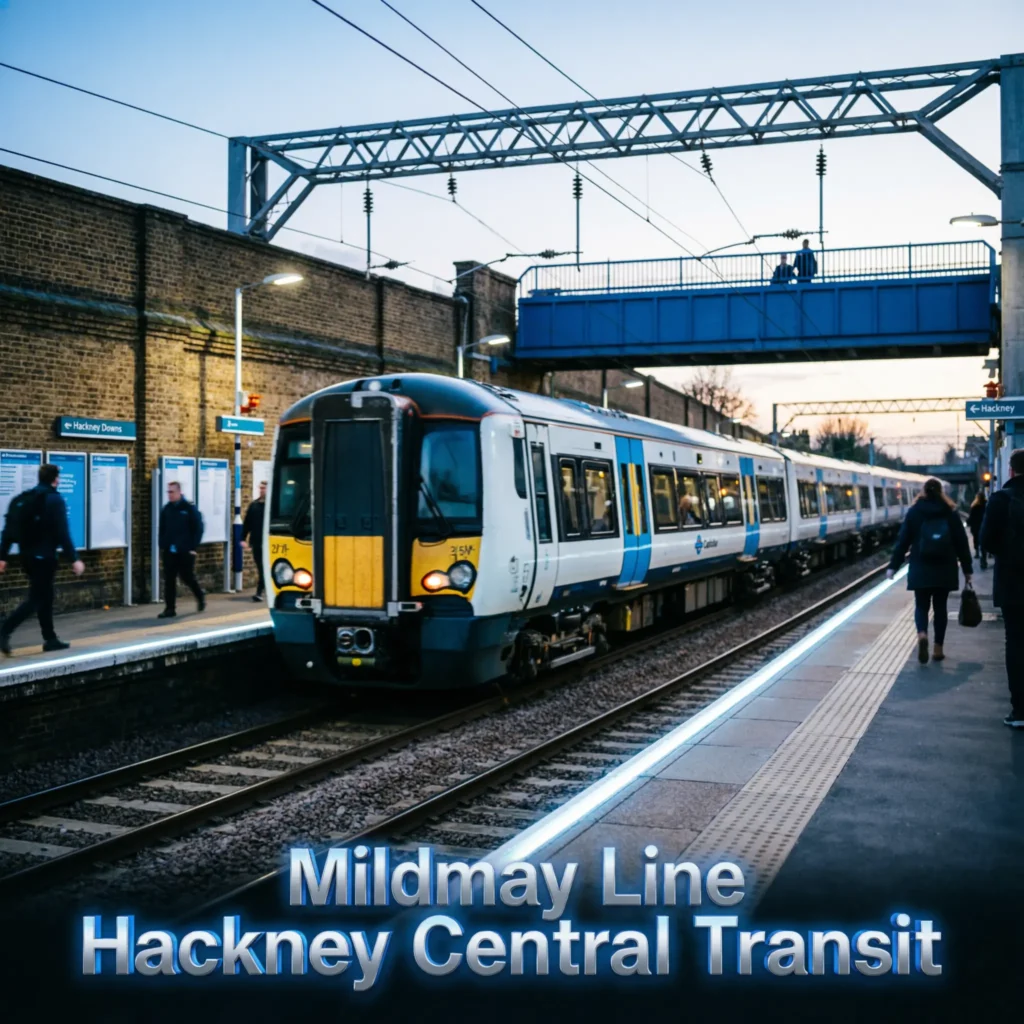
- 🏙️ Hackney Central is on the route.
- 🚉 Hackney Wick is also served.
- 🔄 Hackney Central connects with Hackney Downs nearby.
- 🚆 Other Overground services are accessible.
- 🏘️ The area has many residential communities.
- 🎨 Hackney is known for its creative culture.
- 🌳 Parks and open spaces are nearby.
- 🛍️ Local shopping areas serve residents.
- 🍽️ Restaurants and cafes are common.
- 🎭 Cultural venues are accessible.
- 🏟️ Stratford is close to the east.
- 🚉 Stations support commuter journeys.
- 🚶 Walking connections link nearby areas.
- 📱 TfL information helps with travel planning.
- 🗺️ The Mildmay route improves cross-London connections.
- ⭐ Hackney is an important section of the route.
The Hackney section demonstrates the Mildmay line’s role in connecting neighbourhoods that are not always directly linked by Underground routes. It provides another way to move across London without relying entirely on central interchange stations.
Mildmay Line Map and Route Planning
A Mildmay line map helps passengers understand where the route goes and where they can change trains. TfL’s current map shows the route from Richmond and Clapham Junction to Stratford, along with nearby Underground, National Rail, and other Overground connections. (Transport for London)
- 🗺️ The map shows the full Mildmay route.
- 🚉 Stations are marked along the line.
- 🔄 Interchange stations are identified.
- 🚇 Underground connections are shown.
- 🚆 National Rail connections are shown.
- 🚈 Other Overground routes are identified.
- 📍 Richmond appears at the western end.
- 📍 Clapham Junction appears on the western branch.
- 📍 Stratford appears at the eastern end.
- 🧭 Maps help passengers understand direction.
- ⏱️ Timetables show expected service times.
- 📱 Digital journey planners provide route information.
- 🚧 Engineering work can change routes.
- 🛠️ Weekend closures can occur.
- ♿ Accessibility information can help passengers plan.
- ⭐ Checking TfL before travel is recommended.
A route map is especially helpful for visitors and passengers who are unfamiliar with London’s transport network. It makes it easier to identify where to change and which direction to take.
Mildmay Line Timetable in 2026
The Mildmay line’s timetable changes over time because of planned engineering work, maintenance, and special events. TfL currently lists a timetable valid from 17 May 2026 until further notice. Passengers should check the latest information before travelling, especially on weekends or during public holidays. (Transport for London)
- 📅 Timetables show planned train services.
- 🚆 Services run between Stratford and the western branches.
- ⏰ Departure times vary by station.
- 🌅 Early services may differ from daytime services.
- 🌙 Late services may have different patterns.
- 🛠️ Engineering work can change services.
- 🚧 Partial closures may happen.
- 🚌 Replacement buses can sometimes be used.
- 📱 TfL provides current journey information.
- 🗺️ Journey planners show alternative routes.
- 📆 Public holidays may have amended timetables.
- 🚉 Station information can show service changes.
- ⏱️ Delays can affect connections.
- 🔄 Passengers should allow extra time when changing.
- 🧳 Busy periods may affect journeys.
- ⭐ Checking before departure is a useful habit.
The safest way to plan a Mildmay line journey is to use current TfL information rather than relying on an old timetable. Service patterns can change even when the route itself remains the same.
Mildmay Line History and Name
The Mildmay name was introduced in 2024 when TfL gave the six London Overground routes individual names and colours. The name honours the history of Mildmay, a charitable healthcare organisation with roots in 19th-century London. TfL says the Mildmay story includes its work caring for people during the 1866 cholera outbreak and its later role in HIV and AIDS care. (Made by TfL blog)
- 🏥 Mildmay has a healthcare history.
- 📜 Its story goes back to the 1860s.
- 👩⚕️ Nursing played an important role.
- 🦠 Mildmay workers helped during the cholera outbreak.
- 🏥 A purpose-built hospital opened in 1892.
- 📍 The hospital was associated with Shoreditch.
- ❤️ Its work focused on helping people in need.
- 🌍 Its history later included HIV care.
- 🏳️🌈 It became important to LGBTQ+ communities.
- 👑 Princess Diana visited the hospital.
- 🚆 The Overground line now carries the Mildmay name.
- 🟠 TfL introduced individual Overground line identities.
- 🗺️ The names help passengers navigate the network.
- 🏙️ The names celebrate London’s communities.
- 📚 The Mildmay name preserves an important story.
- ⭐ The line connects transport with local history.
The Mildmay name is therefore not simply a transport label. It reflects a piece of London’s social and healthcare history. TfL chose the name to recognise Mildmay’s contribution to caring for Londoners and its wider community significance. (Made by TfL blog)
Mildmay Line Travel Tips for 2026
Travelling on the Mildmay line is straightforward when you check your route before leaving. Because London Overground services can be affected by engineering works and planned closures, it is useful to check the latest TfL information. This is particularly important if your journey depends on a connection or you are travelling late at night.
- 📱 Check TfL travel information before leaving.
- 🗺️ Look at the route map.
- ⏰ Check departure times.
- 🔄 Plan important connections.
- 🚧 Look for engineering notices.
- 📅 Check weekend service changes.
- 🎫 Make sure you have the correct travel payment method.
- 🚉 Confirm the platform at larger stations.
- ♿ Check accessibility information if needed.
- 🧳 Allow extra time with luggage.
- 🚶 Follow station signs carefully.
- 🔊 Listen for platform announcements.
- 📍 Check the direction of your train.
- 🔄 Confirm your interchange station.
- 📱 Use a journey planner for complex trips.
- ⭐ Recheck your journey if there is a delay.
Good planning can make a Mildmay line journey much easier. The route connects many useful parts of London, but current service information matters because maintenance and temporary changes can affect the normal timetable.
Mildmay Line in 2026: Why It Matters
The Mildmay line is an important part of London’s Overground network because it links communities across several parts of the capital. Its route from Richmond and Clapham Junction to Stratford gives passengers an alternative to travelling through central London. Its individual name also makes the wider Overground system easier to understand. (Transport for London)
- 🚆 It connects west and east London.
- 🏙️ It serves important London neighbourhoods.
- 🔄 It provides useful interchange stations.
- 🚇 It connects with Underground services.
- 🚆 It connects with National Rail.
- 🚈 It connects with other Overground lines.
- 🗺️ Its named route makes navigation easier.
- 🏥 Its name remembers Mildmay’s healthcare history.
- 🏘️ It supports local communities.
- 🎓 It helps people reach education areas.
- 🏢 It supports commuter travel.
- 🛍️ It connects shopping destinations.
- 🌳 It provides access to parks and leisure areas.
- 📱 TfL provides journey-planning information.
- 📅 Current timetables help passengers plan.
- ⭐ It remains an important London transport route in 2026.
The Mildmay line combines transport, history, and community connections. Whether you use it for work, school, sightseeing, or a simple trip across London, understanding the route and its major interchanges can make travelling easier.
Conclusion:
The Mildmay line is a key London Overground route connecting Richmond and Clapham Junction with Stratford. It passes through important stations including Gunnersbury, Willesden Junction, West Hampstead, Gospel Oak, Highbury & Islington, Hackney Central, and Hackney Wick. (Transport for London)
Its name was introduced in 2024 as part of TfL’s new London Overground line identities. The name celebrates the history of Mildmay and its contribution to healthcare in London. (Made by TfL blog)
For 2026 travel, the best approach is to check the latest TfL timetable and service information before starting your journey, especially when travelling at weekends or during planned engineering works.

David Parker is a content writer focused on motivational lines, personal development messages, and powerful words that inspire action.