

A horizontal line is one of the simplest and most important ideas in geometry and coordinate geometry. It moves from left to right and stays at the same height. Because every point on a horizontal line has the same y-coordinate, its slope is always zero. Horizontal lines appear in graphs, shapes, coordinate planes, maps, architecture, screens, tables, and everyday objects. This guide explains the horizontal line definition, horizontal line equation, slope, examples, properties, graphing methods, and differences from vertical lines in simple language for students and learners in 2026.
What Is a Horizontal Line?
A horizontal line is a straight line that goes from left to right without moving up or down. In a coordinate plane, all points on the line have the same y-coordinate.
- ↔️ It moves from left to right.
- ⬅️ It can also be viewed from right to left.
- 📍 All points have the same height.
- 🔢 Its y-coordinate stays constant.
- 📐 Its slope is zero.
- 🧭 It does not rise or fall.
- 📊 It can appear on a graph.
- 📝 It is common in coordinate geometry.
- 🏠 Tables often have horizontal edges.
- 📱 Screens contain horizontal lines.
- 📚 Students learn them in basic geometry.
- 🎯 A horizontal line is different from a vertical line.
- 🔎 Its equation uses one fixed y-value.
- 🧮 It is easy to graph.
- ⭐ It is an important geometry concept.
The key idea is simple:it stays at the same vertical level. If you move along it, the x-value can change, but the y-value does not.
Horizontal Line Definition in Geometry
In geometry, a horizontal line is a line that runs parallel to the x-axis. It has no vertical change as it moves from one point to another.
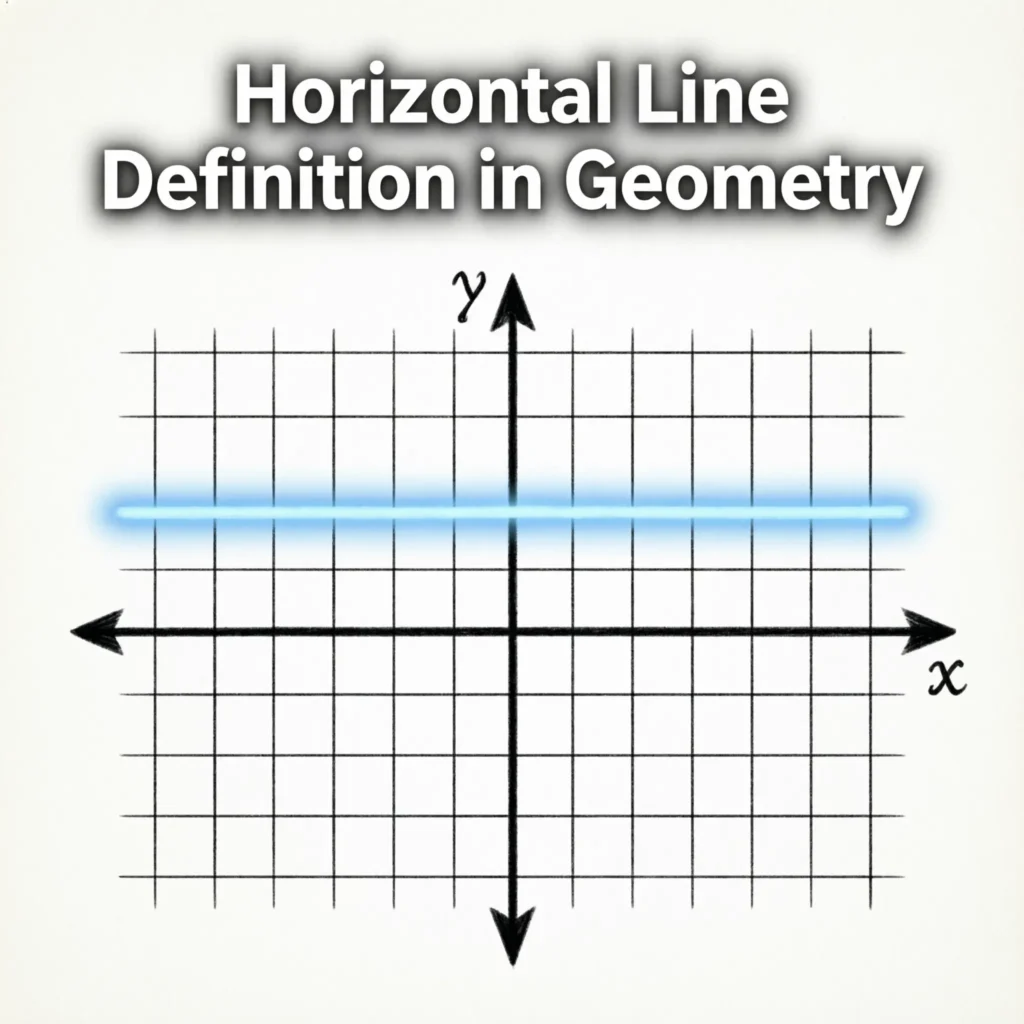
- 📏 It is a straight line.
- ↔️ It runs from left to right.
- 📊 It is parallel to the x-axis.
- 📍 Its y-value remains fixed.
- 🧮 Its slope equals zero.
- 📐 It has a constant height.
- 🔢 Different x-values can appear on it.
- 🟰 The y-coordinate stays the same.
- 📈 It does not rise.
- 📉 It does not fall.
- 🧭 It has no vertical movement.
- 📚 It is used in coordinate geometry.
- 📝 It can be represented by an equation.
- 🔎 It can contain many points.
- 🎯 It is easy to identify on a graph.
- ⭐ It is one of the basic types of straight lines.
A useful way to remember the definition is to imagine a flat ruler placed across a coordinate grid. The ruler does not move upward or downward, so it represents a horizontal line.
Horizontal Line on a Coordinate Plane
On a coordinate plane, it follows the direction of the x-axis. You can identify it by checking whether the y-coordinate stays the same at different points.
- 📊 The x-axis itself is horizontal.
- 📍 It can also be below the x-axis.
- 🔢 Its points share the same y-coordinate.
- ↔️ The x-coordinate can change.
- 📐 Its slope is zero.
- 🧭 It extends left and right.
- 🟰 The y-value remains constant.
- 📈 It does not move upward.
- 📉 It does not move downward.
- 📝 Points can be plotted along it.
- 🎯 It is easy to recognize visually.
- 📚 It is useful for graphing equations.
- 🔎 It helps students understand slope.
- 🧮 It can represent a simple linear equation.
- ⭐ Coordinate geometry uses horizontal lines often.
For example, the points (1, 4), (3, 4), and (7, 4) all lie on the same horizontal line because their y-coordinate is always 4.
Horizontal Line Equation
The equation of a horizontal line is usually written as y = c, where c is a constant number. This means that the y-coordinate never changes.
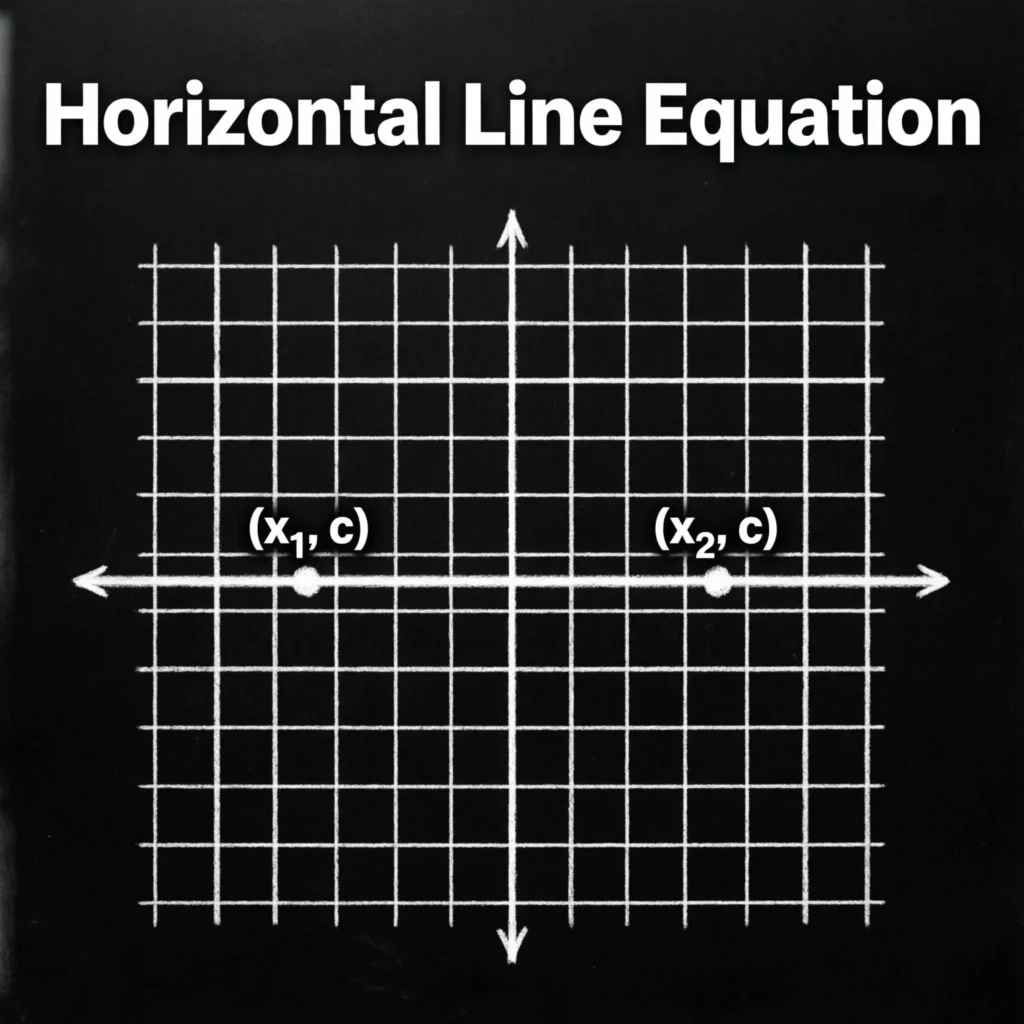
- 🧮 The basic form is y = c.
- 🔢 The letter c represents a constant.
- 📍 Every point has the same y-value.
- ↔️ The x-value can change.
- 📏 The line extends horizontally.
- 📐 Its slope is zero.
- 📝 Example: y = 3.
- 📊 Every point on y = 3 has height 3.
- 🎯 The line crosses the y-axis at 3.
- 🔎 Another example is y = -2.
- 📍 Points can be above or below the x-axis.
- 🧭 The equation does not need an x-term.
- 📚 It is a simple linear equation.
- 🧮 It can be graphed quickly.
- ✏️ Students can draw it across the grid.
- ⭐ Remember: horizontal means y stays fixed.
For example, y = 5 means every point has a y-coordinate of 5. Points such as (0, 5), (2, 5), and (8, 5) all belong to that horizontal line.
Slope of a Horizontal Line
The slope of a horizontal line is zero. Slope measures how much a line rises or falls as it moves from one point to another.
- 📐 Slope measures change in a line.
- 🧮 The slope formula is rise over run.
- 0️⃣ Its vertical change is zero.
- ↔️ It can still have horizontal movement.
- 🧮 Zero divided by a nonzero number is zero.
- 📏 Therefore, its slope is 0.
- 📍 Points on it have equal y-values.
- 📈 It does not rise.
- 📉 It does not fall.
- 📝 Example points: (2, 4) and (8, 4).
- 🔢 The y-change is 4 − 4 = 0.
- ↔️ The x-change is 8 − 2 = 6.
- 🧮 Slope = 0 ÷ 6 = 0.
- 🎯 This works for every horizontal line.
- ⭐ Zero slope is a key property.
The easiest memory trick is: horizontal = zero slope. A horizontal road, shelf, or line across a page does not rise or fall, which helps explain why its slope is zero.
Horizontal Line Examples
Horizontal lines appear in mathematics and in many ordinary objects. Looking for familiar examples can make the concept easier to understand.
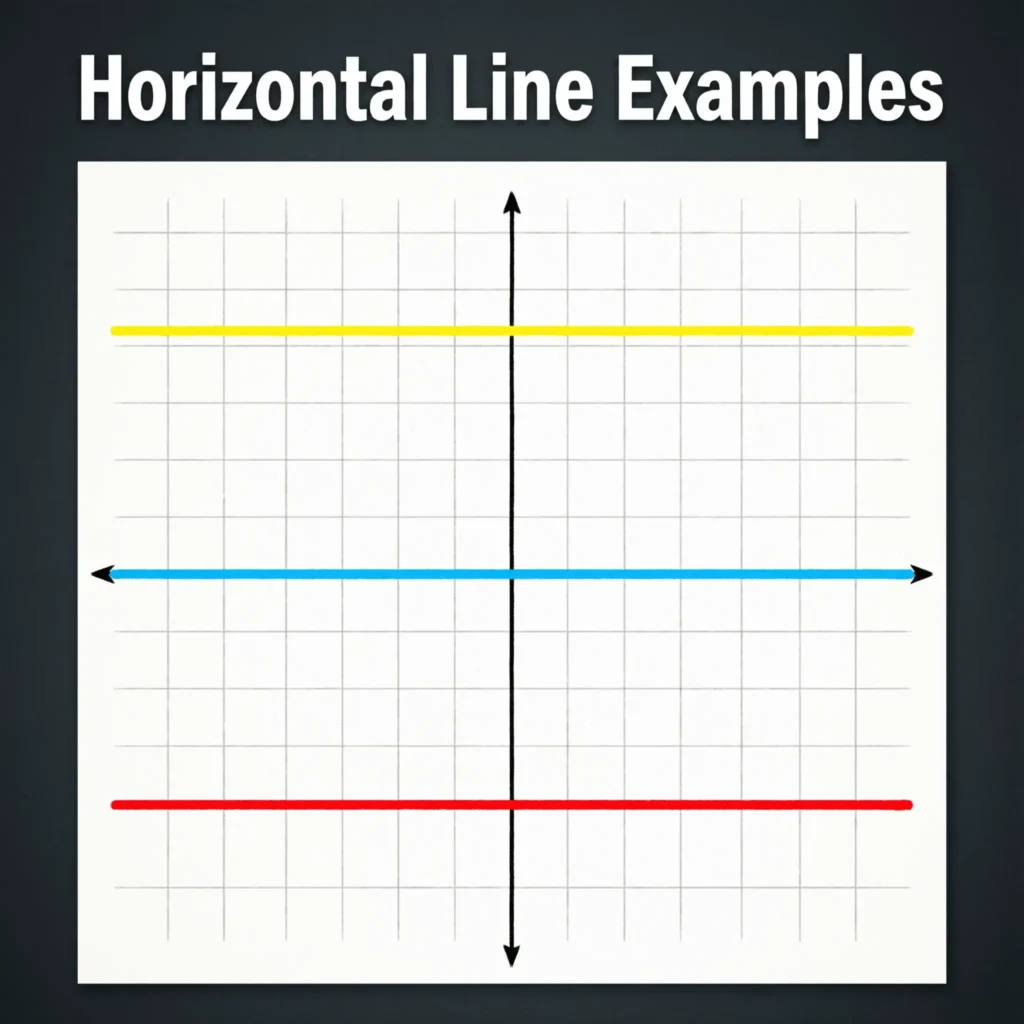
- 📚 The edge of a book can be horizontal.
- 🪑 A level shelf can be horizontal.
- 🖥️ The top edge of a computer screen can be horizontal.
- 📺 A television screen has horizontal edges.
- 🏠 A level floor can form a horizontal line.
- 🚪 The top of a door can be horizontal.
- 🪟 A window frame can have horizontal edges.
- 📏 A ruler placed flat can show one.
- 📝 A line drawn across paper can be horizontal.
- 📊 A graph may contain horizontal lines.
- 🛣️ A level road can appear horizontal.
- 🏗️ Building beams can be horizontal.
- 🧱 The top edge of a wall can be horizontal.
- 📐 Rectangle sides can include horizontal lines.
- 🗺️ Maps can contain horizontal reference lines.
- ⭐ These examples connect geometry to daily life.
These everyday examples show that horizontal lines are not only classroom ideas. They describe objects and surfaces that stay at the same level from one side to another.
Horizontal Line vs Vertical Line
A horizontal line and a vertical line are both straight lines, but they move in different directions. Knowing the difference is important when reading graphs and solving coordinate geometry questions.
- ↔️ Horizontal lines move left and right.
- ↕️ Vertical lines move up and down.
- 📐 Horizontal slope is zero.
- 🧮 Vertical slope is undefined.
- 📍 Horizontal lines have constant y-values.
- 📍 Vertical lines have constant x-values.
- 📊 The x-axis is horizontal.
- 📊 The y-axis is vertical.
- 📝 Horizontal equation: y = c.
- 📝 Vertical equation: x = c.
- 🔢 Horizontal lines can have changing x-values.
- 🔢 Vertical lines can have changing y-values.
- 📏 Both are straight lines.
- 🧭 They meet at right angles when they intersect.
- 🎯 Both are important in coordinate geometry.
- ⭐ Learning the difference prevents common mistakes.
A quick memory trick is “horizontal = y stays the same” and “vertical = x stays the same.”
Horizontal Line and X-Axis
The x-axis is itself a horizontal line. It divides the coordinate plane into an upper and lower half and provides the reference point for horizontal movement.
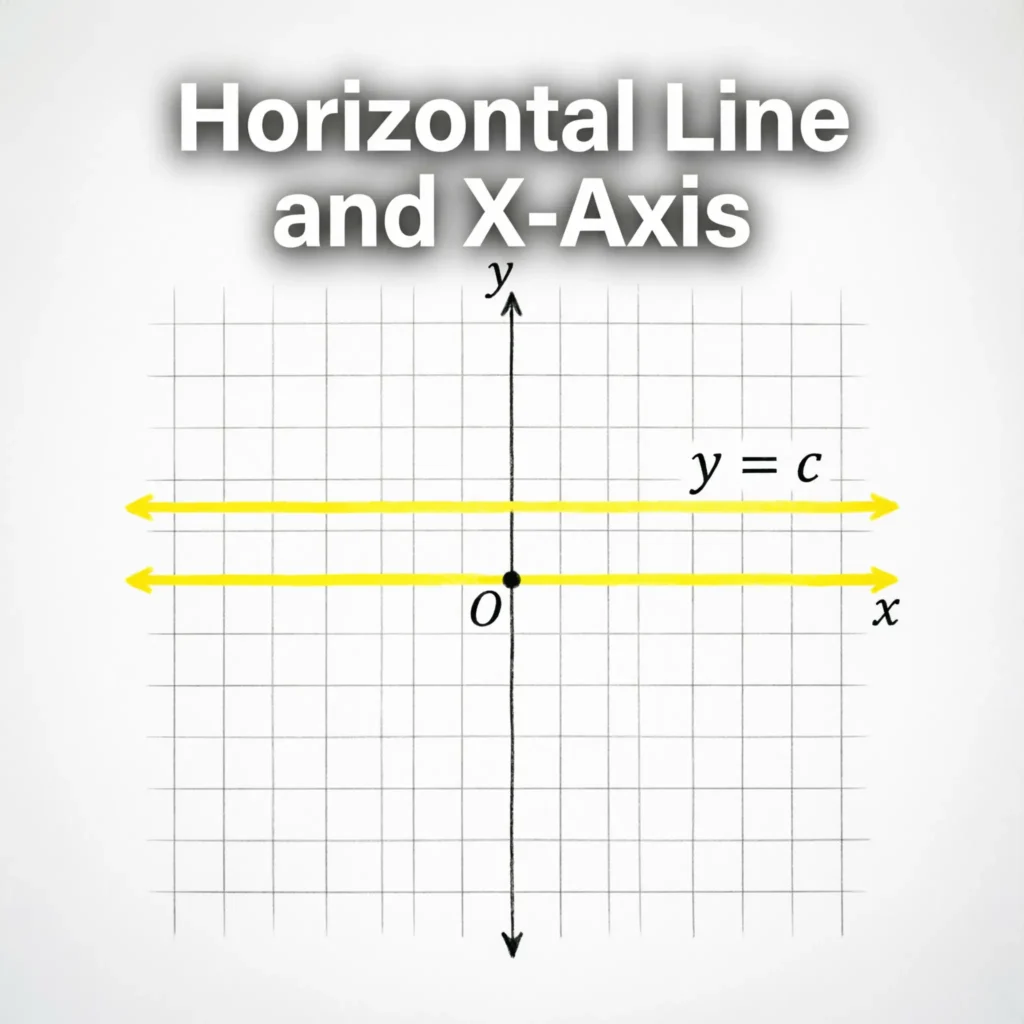
- 📊 The x-axis is horizontal.
- 0️⃣ Its y-coordinate is always zero.
- ↔️ It extends left and right.
- 📍 Points above it have positive y-values.
- 📍 Points below it have negative y-values.
- 🔢 The x-value can change.
- 🧮 Its equation is y = 0.
- 📐 Its slope is zero.
- 📝 It is a major coordinate reference line.
- 🎯 It helps locate points.
- 📚 Students use it when graphing.
- 📊 It forms part of the Cartesian plane.
- 🧭 It provides horizontal direction.
- 🔎 It helps compare vertical positions.
- ✏️ It is easy to draw on graph paper.
- ⭐ It is the most familiar horizontal line in coordinate geometry.
Understanding the x-axis makes it easier to understand every other horizontal line because all horizontal lines are parallel to the x-axis.
Horizontal Line and Y-Coordinate
The y-coordinate tells us how high or low a point is on a coordinate plane. For a horizontal line, this value remains the same for every point.
- 📍 The y-coordinate shows vertical position.
- 🟰 A horizontal line has one fixed y-value.
- 🔢 The x-coordinate can change.
- 📊 Points may have different x-values.
- 📐 Their y-values remain equal.
- 📝 Example: (1, 6) and (9, 6).
- 🔎 Both points have y = 6.
- ↔️ They form a horizontal direction.
- 🧮 Their slope is zero.
- 📏 They lie at the same height.
- 🎯 This property identifies horizontal lines.
- 📚 It is important in graphing.
- 🧠 It helps students understand coordinates.
- 📝 Equations often use y = constant.
- 📊 It makes horizontal graphs easy to recognize.
- ⭐ Same y-coordinate means horizontal alignment.
If two points have the same y-coordinate, you can immediately tell that the straight line joining them is horizontal.
How to Draw a Horizontal Line
Drawing a horizontal line on graph paper is simple. You only need to choose a fixed y-value and mark points along that level.
- ✏️ Start with a coordinate grid.
- 📍 Choose a y-value.
- 🔢 For example, choose y = 4.
- 📌 Mark one point at (0, 4).
- 📌 Mark another at (5, 4).
- 📌 Mark more points if needed.
- ↔️ Keep all points at the same height.
- 📏 Use a ruler to connect them.
- 🧮 Check that the y-value stays 4.
- 📐 Confirm the line does not rise.
- 📊 Extend the line left and right.
- 📝 Label the equation y = 4.
- 🎯 Check the slope.
- 0️⃣ The slope should be zero.
- 🔎 Compare it with the x-axis.
- ⭐ Your horizontal line is complete.
The most important step is keeping every point at the same y-coordinate. If one point moves up or down, the line is no longer horizontal.
Horizontal Line in Geometry Shapes
Horizontal lines are common in geometric shapes. Rectangles, squares, parallelograms, and other figures can contain horizontal sides depending on their position.
- ▫️ A rectangle can have two horizontal sides.
- ⬜ A square can have two horizontal sides.
- 🔷 A parallelogram can have horizontal sides.
- 📐 Geometric sides can be horizontal.
- 📏 Horizontal sides can be measured.
- 🧮 Their slope can be zero.
- ↔️ They run parallel to the x-axis.
- 📍 Their endpoints have equal y-values.
- 🔺 Triangles can sometimes have one horizontal side.
- ⭕ Horizontal chords can appear in circles.
- 🏗️ Geometric diagrams often use horizontal segments.
- 📚 Students use them in geometry problems.
- ✏️ They help describe shape orientation.
- 📊 Coordinate geometry uses horizontal sides.
- 🎯 They can help calculate area.
- ⭐ They are common in mathematical diagrams.
When a shape is placed on a coordinate plane, checking which sides are horizontal can help with measurements, slopes, and equations.
Horizontal Line Segment
A horizontal line segment is a finite part of a horizontal line. Unlike a complete line, it has two endpoints and does not continue forever.
- 📏 A line segment has two endpoints.
- ↔️ A horizontal segment runs left to right.
- 📍 Its endpoints have the same y-coordinate.
- 🧮 Its slope is zero.
- 📐 It has a measurable length.
- 🔢 Its x-values can differ.
- 📝 Example: (2, 3) to (8, 3).
- 📊 Both endpoints have y = 3.
- 📏 Its length is 6 units.
- 🏠 Horizontal edges can be segments.
- ▫️ Rectangles contain horizontal segments.
- ⬜ Squares contain horizontal segments.
- 📚 Geometry problems often use them.
- ✏️ They are easy to draw.
- 🎯 They can form sides of shapes.
- ⭐ A segment is shorter than a complete line.
A horizontal segment is useful when a problem asks for the distance between two points that have the same y-coordinate.
Horizontal Line in Real Life
Horizontal lines are everywhere in the world around us. They can describe level surfaces, edges, markings, structures, and designs.
- 🏠 Floors can be horizontal.
- 🪑 Tables have horizontal surfaces.
- 📚 Shelves often have horizontal edges.
- 🪟 Window frames can include horizontal lines.
- 🚪 Doors have horizontal edges.
- 🛣️ Level roads can look horizontal.
- 🏗️ Construction beams can be horizontal.
- 🧱 Brick courses can create horizontal patterns.
- 🖥️ Computer screens have horizontal edges.
- 📺 Television screens have horizontal edges.
- 📱 Phone displays contain horizontal boundaries.
- 🏊 Pool edges can be horizontal.
- 🌅 Horizons appear horizontal.
- 🗺️ Maps use horizontal reference lines.
- 🏟️ Stadium structures can contain horizontal levels.
- ⭐ Geometry helps describe these real-world designs.
Seeing horizontal lines in familiar objects makes the mathematical definition easier to remember and apply.
Horizontal Line in Graphs and Data
Horizontal lines are also useful when reading graphs and data. They can show constant values, limits, targets, or levels that do not change.
- 📊 Graphs can contain horizontal lines.
- 🧮 A constant value can be shown horizontally.
- 🎯 A target level may use a horizontal line.
- 📈 A reference line can show a fixed value.
- 📉 A limit can be displayed horizontally.
- 📍 Every point has the same y-value.
- 📝 The equation can be y = constant.
- 🔎 It can help compare data.
- 📊 Charts may use horizontal guide lines.
- 🎯 A goal line can remain fixed.
- 📚 Students use them in data questions.
- 💻 Digital dashboards can use horizontal reference lines.
- 🧮 The slope remains zero.
- ↔️ The line stretches across the graph.
- 📐 It helps identify constant quantities.
- ⭐ Horizontal lines make some graphs easier to read.
In data visualization, a horizontal reference line can quickly show whether values are above, below, or equal to a chosen level.
Horizontal Line in 2026 Learning and Education
In 2026, students can learn horizontal lines through traditional graph paper as well as interactive digital tools. Coordinate geometry is often easier to understand when learners can move points and see how the line changes.
- 💻 Digital graphing tools can show horizontal lines.
- 📱 Learning apps can display coordinate planes.
- 🖥️ Interactive graphs help students explore slopes.
- ✏️ Paper and pencil remain useful.
- 📊 Online graphing can show y = constant.
- 🎯 Students can move points on a graph.
- 🧮 Slope can be calculated automatically.
- 📚 Teachers can use visual examples.
- 🔎 Interactive lessons can show coordinate changes.
- 🧠 Visual learning helps explain difficult ideas.
- 📝 Practice questions reinforce the concept.
- 🎓 Exam preparation often includes coordinate geometry.
- 📐 Horizontal and vertical lines can be compared.
- 🌐 Digital resources make practice easier.
- ⭐ Simple examples remain important.
- 🚀 Understanding the basics supports more advanced algebra.
Modern tools can make the concept more visual, but the core rule has not changed: a horizontal line has a constant y-coordinate and zero slope.
Horizontal Line FAQs
- ❓ What is a horizontal line? A horizontal line is a straight line that runs left to right and stays at the same vertical level.
- 📐 What is the slope of a horizontal line? The slope of a horizontal line is zero.
- 🧮 What is the equation of a horizontal line? Its equation is usually written as y = c, where c is a constant.
- 📍 What stays constant on a horizontal line? The y-coordinate stays constant.
- 🔢 Can the x-coordinate change on a horizontal line? Yes. The x-coordinate can change while the y-coordinate remains the same.
- 📊 Is the x-axis a horizontal line? Yes. The x-axis is horizontal and has the equation y = 0.
- 🎯 What does y = 5 mean? It represents a horizontal line where every point has a y-coordinate of 5.
- 📚 How do I identify a horizontal line? Check whether the line moves left and right without rising or falling.
- 🧮 Can a horizontal line have a negative y-value?
- 📍 Do two points with the same y-coordinate form a horizontal line? Yes, provided they have different x-coordinates.
- 📝 What is a horizontal line segment? It is a finite part of a horizontal line with two endpoints at the same y-coordinate.
Conclusion:
A horizontal line is a straight line that moves from left to right while staying at the same height. Its most important properties are simple: it is parallel to the x-axis, has a constant y-coordinate, and has a slope of zero. The standard equation is y = c.
Understanding horizontal lines helps students solve coordinate geometry problems, recognize geometric shapes, read graphs, and understand everyday structures. Whether you are preparing for an exam or learning geometry basics in 2026, remembering “horizontal means constant y and zero slope” makes this topic much easier.

Andrew Collins creates inspiring content centered around success, motivation, leadership, and positive thinking.